
















































































































































































Delhi Weather Crisis and the Role of Government: Challenges, Accountability, and the Way Forward.
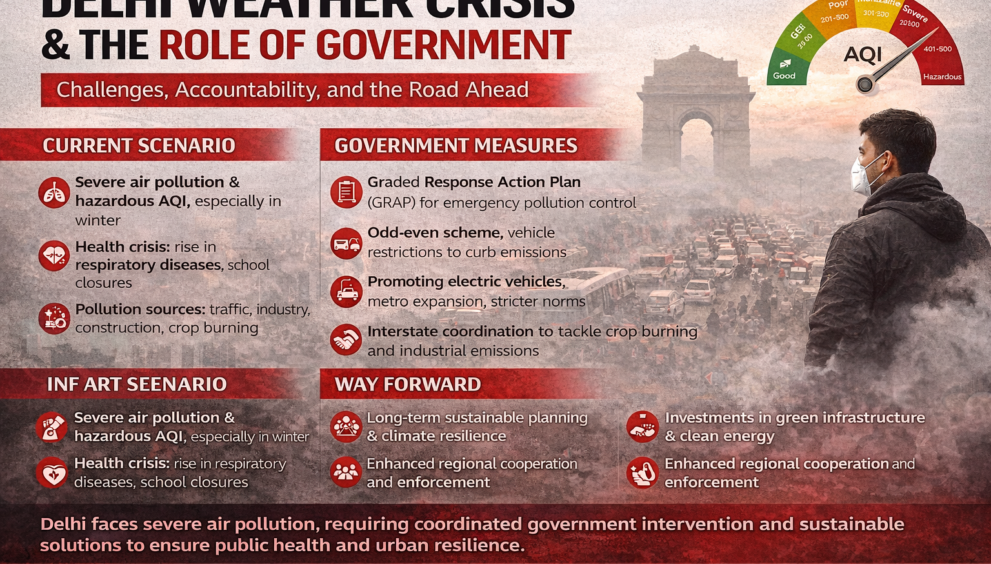

- Delhi’s worsening weather and hazardous air quality are driven not only by climatic factors but also by unchecked urbanization, vehicular emissions, and regional pollution sources.
- Government initiatives such as GRAP, odd-even schemes, and electric mobility policies have provided short-term relief but require stronger enforcement and long-term planning.
- Sustainable urban development, regional coordination, and climate-resilient governance are essential to securing Delhi’s environmental future and protecting public health.
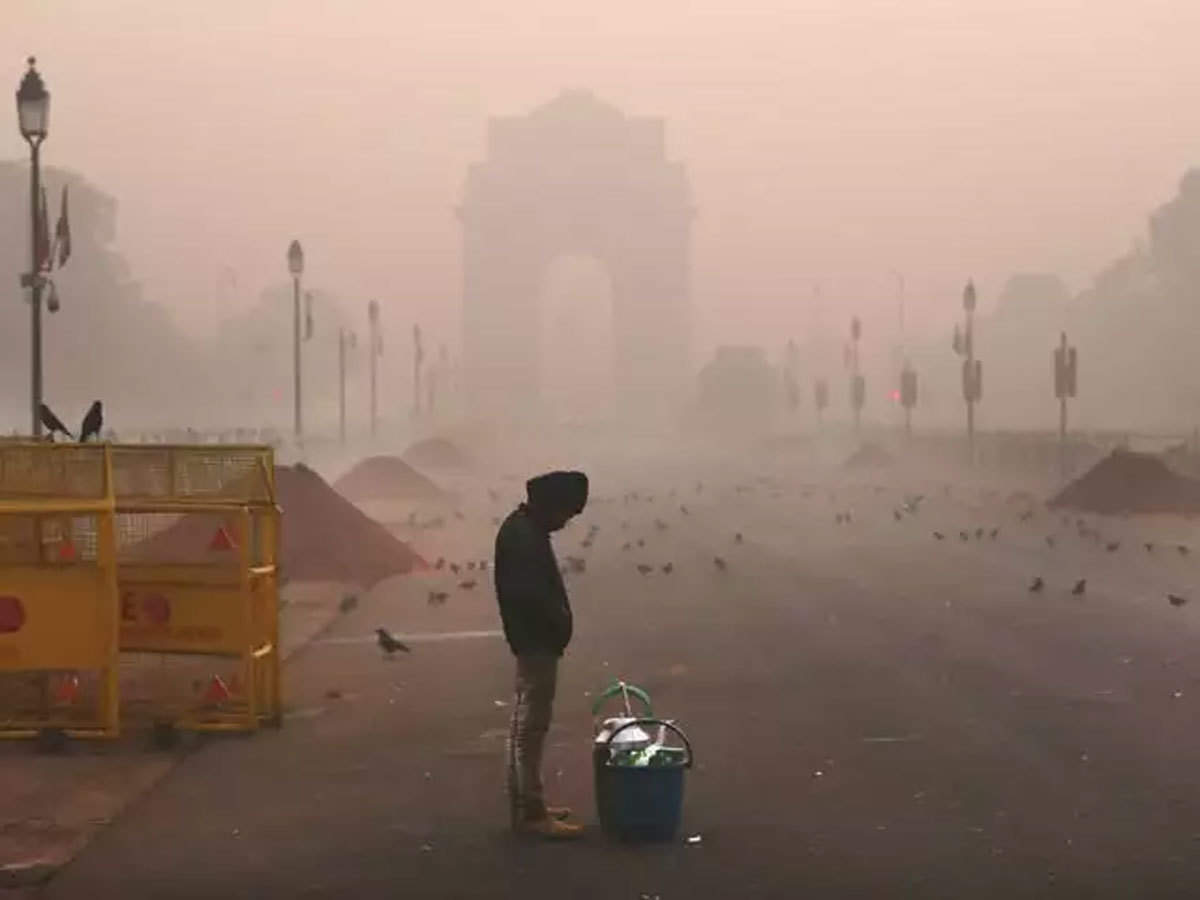
Delhi’s weather has become a recurring national concern, especially during the winter months when air pollution, dense smog, and extreme cold dominate headlines. Once known for its seasonal diversity, the national capital now struggles with hazardous air quality, unpredictable temperature patterns, and worsening climate stress. The deteriorating weather conditions in Delhi are not merely a natural phenomenon; they are deeply connected to policy decisions, urban planning, and the effectiveness of government intervention.
Understanding Delhi’s Weather Problem
Delhi’s weather crisis is most visible during winter, when cold temperatures combine with high pollution levels to create toxic smog. The Air Quality Index (AQI) frequently reaches “severe” levels, posing serious health risks to residents. Reduced wind speed, low temperatures, and temperature inversion trap pollutants close to the ground, making breathing difficult for millions.
While meteorological factors play a role, experts agree that weather alone is not responsible. Vehicular emissions, construction dust, industrial pollution, crop residue burning in neighboring states, and rapid urbanization significantly worsen Delhi’s weather conditions. Climate change has further intensified heatwaves in summer and extended pollution episodes in winter.
Health Impact of Delhi’s Weather and Pollution
The impact of Delhi’s weather crisis on public health is severe and long-lasting. Hospitals report a sharp rise in respiratory illnesses, asthma cases, heart problems, and eye irritation during high-pollution periods. Children, senior citizens, and people with pre-existing conditions are the most affected.
Studies have linked Delhi’s poor air quality to reduced life expectancy and long-term lung damage. Schools are often forced to shut down, outdoor activities are restricted, and work productivity declines. The economic cost of health emergencies and lost working hours runs into billions each year.
Government Measures to Tackle Delhi Weather and Pollution
Over the years, both the central and Delhi governments have introduced multiple policies to address the weather and pollution crisis. The Graded Response Action Plan (GRAP) is one of the most prominent initiatives, activated during high-pollution periods. It includes restrictions on construction activities, bans on diesel generators, vehicle curbs, and industrial shutdowns.
The odd-even vehicle scheme has been implemented multiple times to reduce traffic congestion and emissions. The government has also promoted electric vehicles (EVs), expanded metro connectivity, and introduced stricter emission norms for industries and automobiles.
Additionally, the Supreme Court-mandated Commission for Air Quality Management (CAQM) oversees pollution control measures across Delhi-NCR, ensuring coordination between states.
Challenges in Policy Implementation
Despite multiple policies, Delhi’s weather and air quality continue to deteriorate, raising questions about implementation and accountability. One major challenge is fragmented governance. Pollution sources lie not only within Delhi but across neighboring states, making coordinated action difficult.
Enforcement gaps remain a persistent issue. Construction bans are often violated, industrial compliance is inconsistent, and monitoring mechanisms lack transparency. Political disagreements between state and central governments further slow decision-making during critical periods.
Another challenge is short-term planning. Emergency measures provide temporary relief but fail to address long-term structural problems such as over-dependence on private vehicles, weak public transport integration, and unregulated urban expansion.
Role of Climate Change and Urban Planning
Climate change has amplified Delhi’s weather extremes. Rising temperatures have increased the frequency of heatwaves, while erratic rainfall patterns affect air circulation and pollution dispersion. Urban heat islands—created by concrete structures, loss of green cover, and dense construction—worsen temperature stress.
Urban planning decisions over decades have prioritized infrastructure expansion over environmental sustainability. Reduction in green spaces, shrinking water bodies, and uncontrolled construction have reduced Delhi’s natural ability to regulate its climate. Experts argue that weather resilience must become central to future development plans.
Government Accountability and Public Expectations
As the capital of India, Delhi’s weather crisis has become a symbol of governance challenges. Citizens increasingly demand accountability, transparency, and long-term solutions rather than seasonal announcements. Public trust depends on measurable outcomes, not policy declarations.
The government’s role extends beyond regulation. Public awareness campaigns, incentives for sustainable behavior, and citizen participation are crucial. Waste segregation, reduced vehicle usage, and energy conservation require collective action supported by clear government leadership.
Technological and Policy Innovations
Technology offers new opportunities to manage Delhi’s weather crisis. Real-time air quality monitoring, satellite-based pollution tracking, and data-driven policy planning can improve decision-making. Artificial intelligence and predictive models can help forecast pollution episodes and enable preventive action.
Policy innovations such as congestion pricing, stricter fuel quality standards, and large-scale adoption of renewable energy are gaining attention. Expanding green corridors, urban forests, and rooftop solar installations can significantly improve micro-climate conditions.
The Way Forward: From Crisis to Climate Resilience
Solving Delhi’s weather crisis requires a shift from reactive to preventive governance. Long-term planning must integrate climate resilience, sustainable transport, and regional cooperation. Coordination between Delhi and neighboring states is essential to address shared pollution sources.
Investments in public transport, electric mobility, green infrastructure, and clean energy must be accelerated. Transparent enforcement, independent monitoring, and citizen engagement can rebuild public confidence.
Delhi’s weather is not just an environmental issue—it is a governance challenge that reflects the priorities of urban development and public policy. How governments respond today will determine whether future generations inherit a livable capital or a permanent climate emergency.
Conclusion
Delhi’s worsening weather conditions highlight the urgent need for effective governance, regional coordination, and sustainable planning. While natural factors play a role, human activity and policy gaps remain the primary drivers of the crisis. The government’s responsibility lies in delivering long-term, science-based solutions that protect public health and restore environmental balance.
As climate challenges intensify, Delhi’s response can serve as a model—or a warning—for other Indian cities. The choices made now will shape the capital’s climate future for decades to come.