


















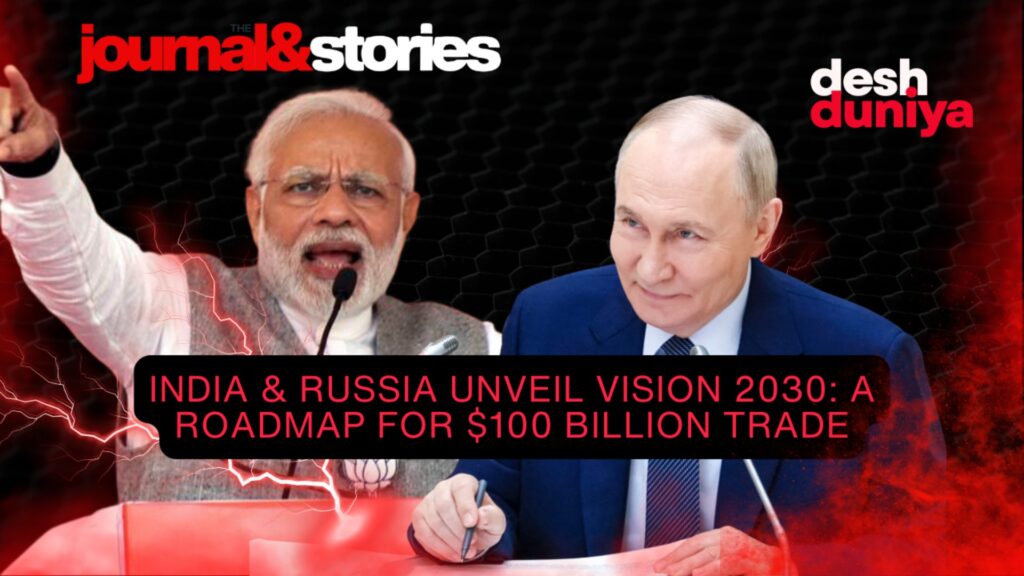
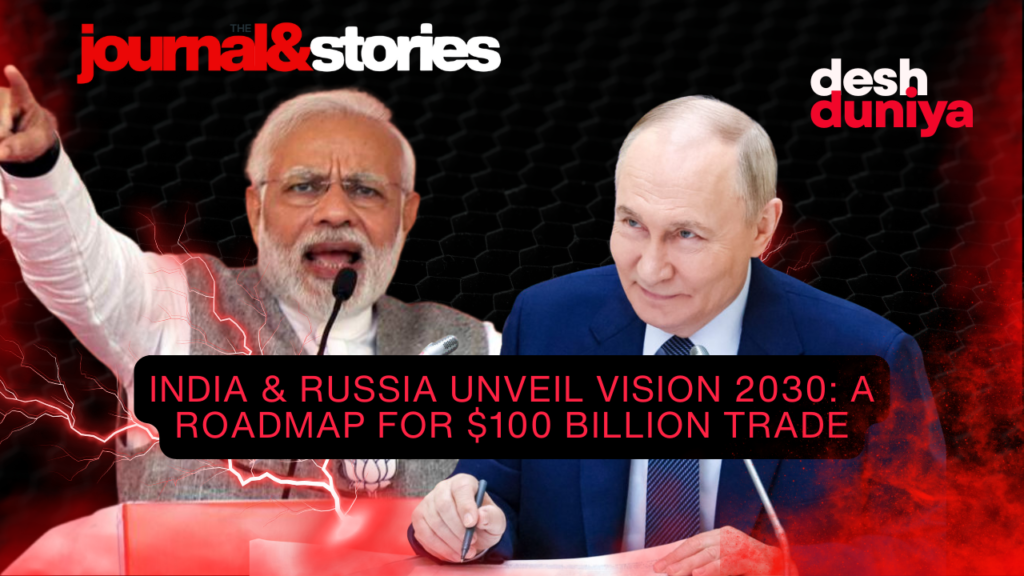








































































































































India, Russia Chart Ambitious Trade Course: Targeting $100 Billion by 2030.
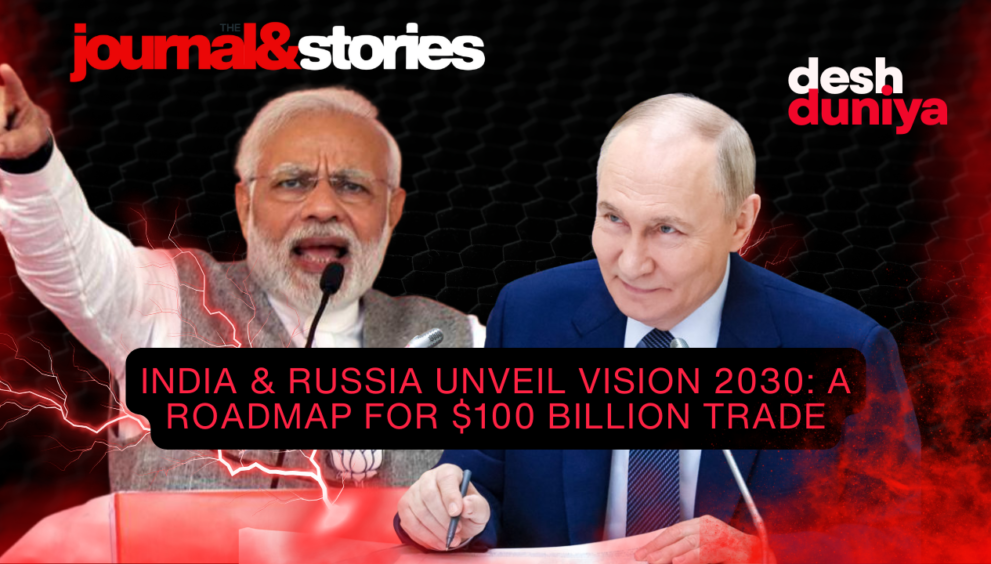

- India and Russia set an ambitious goal to boost bilateral trade to US$100 billion by 2030 under the new “Vision 2030” roadmap.
- The partnership expands far beyond oil and defence — covering agriculture, pharmaceuticals, infrastructure, nuclear energy, digital economy, and new transport corridors.
- A proposed rupee–ruble settlement system, improved logistics routes, and balanced export growth aim to correct India’s massive trade deficit and reshape long-term strategic cooperation.
New Delhi — At the conclusion of the 23rd annual summit between India and Russia, leaders from both countries unveiled an ambitious roadmap to deepen economic cooperation and expand bilateral trade to US$100 billion by 2030.
Under this renewed pact — informally dubbed “Vision 2030” — India and Russia committed to broaden the scope of their trade and investment partnership, moving well beyond traditional domains like energy and defence, and embracing a diversified basket of goods, services, joint ventures and infrastructure cooperation.
From Imbalance to Balance: Why Diversification Matters
Historically, trade between India and Russia has been heavily skewed in favour of Moscow. In 2024–25, India’s exports to Russia were just about US$4.9 billion, while imports — especially of crude oil and related energy products — stood at nearly US$63.8 billion. This created a trade deficit of roughly US$59 billion, a gap New Delhi is now eager to narrow.
At a business-forum ahead of the summit, India’s Commerce Minister urged both sides to work toward “stronger, more balanced trade.”
To recalibrate the trade equation, India is pitching a host of sectors for export growth: consumer goods, food products, automobiles, electronics (including smartphones), industrial components, textiles, and more. The services sector also figures prominently — Indian IT/BPM, healthcare, education, and creative-services firms see growing opportunity in the Russian market.
Beyond Oil: Sectors, Routes, and New Opportunities
Under the new cooperation plan, trade is not limited to energy or defence. The agreement envisages cooperation across a wide array of sectors: agriculture and food, fertilisers, pharmaceuticals, infrastructure and industrial manufacturing, shipbuilding, nuclear power, and digital economy initiatives.
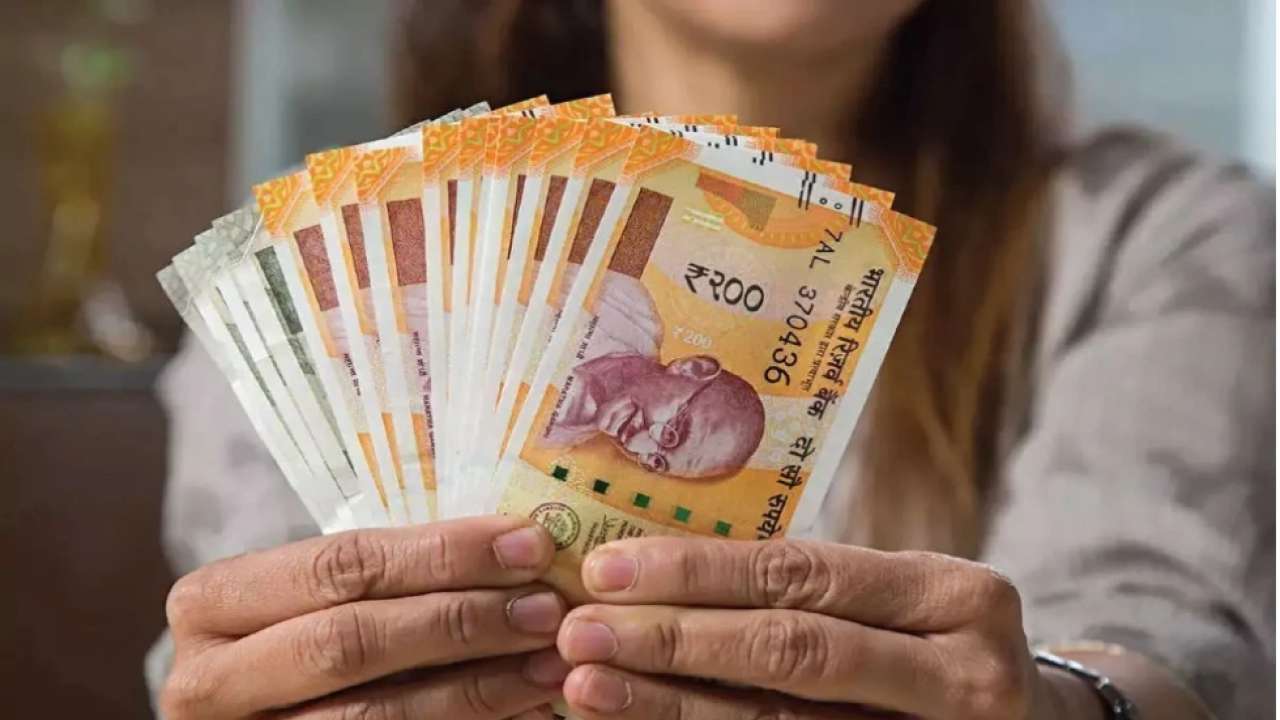
One major step: development of a bilateral settlement system using national currencies — rupees and rubles — for trade transactions. This move could reduce dependence on hard currencies and simplify trade especially in energy deals.
Connectivity and logistics are also being revamped. The trade agreement explores new trade routes and corridors, such as the northern sea routes, the long-discussed North-South Transport Corridor, and a Chennai–Vladivostok sea line. Digitalization of customs and streamlined cargo processes are part of the strategy to reduce transaction friction.
On infrastructure and industrial collaboration, both sides plan to encourage joint ventures, facilitate easier entry of Indian companies into Russian markets (and vice versa), and collaborate on large projects — from fertiliser plants to critical-minerals supply chains, shipbuilding, and high-tech manufacturing.
In energy, besides continuing oil and gas cooperation, the partnership is looking at nuclear energy, including small modular reactors, floating nuclear power plants and non-energy nuclear applications like agriculture and medicine.
New Geopolitics, Same Old Trust: A Timely Reaffirmation
The summit’s timing and tone underscore that this partnership persists even amid shifting global geopolitics. Despite increasing pressure from Western powers, particularly the United States, to limit economic engagement with Russia, India has reaffirmed its right to protect its strategic autonomy and pursue national interest.
For Russia, the desire is clear: diversify export markets beyond hydrocarbons, and deepen ties with a fast-growing and stable Asian economy. For India, the goal is to secure stable energy supply, access to critical minerals and defense collaboration — while opening new markets for Indian goods and services.
Both leaders have expressed confidence that the $100 billion mark could be reached before 2030, given the “tremendous potential” and accelerating pace of cooperation.
What Must India and Russia Watch Out For — Challenges & Bottlenecks
The roadmap is ambitious — and realizing it will not be easy. First, India must substantially scale up exports to Russia in many non-traditional sectors. Achieving this requires firms to adapt to Russian demand patterns, meet regulatory and quality standards, and navigate Russia’s sometimes opaque trade and customs regime.
Second, building the infrastructure — both physical (transport corridors, ports, industrial clusters) and financial (rupee–ruble settlement, banking ties) — will require sustained cooperation, regulatory clarity, and mutual trust.
Third, geopolitical pressure, sanctions, and global economic instability remain real risks. Despite India’s insistence on strategic autonomy, alignment with Russia could attract diplomatic and trade pushback from major global powers.
Finally, to reap benefits for local Indian industries, domestic policy support will be essential: supply-chain readiness, export incentives, ease of doing business and support for sectors like agriculture, leather, pharmaceuticals and manufacturing.
What It Means for Ordinary Indians – Opportunities + Realities
If fully realized, the India–Russia economic surge could create concrete opportunities for Indian producers — from farmers exporting marine and food products to exporters of textiles, leather, pharmaceuticals, electronics and more.
Industries like heavy machinery, automobile components, ship-building, fertilisers and mining could see joint ventures and investment inflows. Infrastructure projects — transport corridors, ports, and logistics chains — may generate jobs. Defence-industrial collaboration could bring the “Make in India” vision into newer geographies.
Most importantly, a more balanced trade — less dependent on oil imports — could help insulate India’s economy from global energy price shocks. A robust RU-RUPEE/ROUBLE mechanism may stabilize trade flows and reduce pressure on foreign-exchange reserves.
Conclusion: A Strategic Bet on Long-Term Partnership
The India–Russia “Vision 2030” is more than just numbers — it is a bold strategic bet. By broadening the cooperation canvas beyond energy and defence, by weaving together trade, infrastructure, technology, labour mobility, critical-minerals, food security, and financial connectivity, both nations are redefining their economic relationship for a shifting global order.
For India, this partnership offers a path to diversify exports, secure energy and resources, and deepen industrial and technological collaboration. For Russia, India represents a stable, high-growth market and a gateway to the wider Global South.
If the promises translate into execution, and the two sides navigate political and economic headwinds successfully — the subcontinent and Eurasia might witness one of the most consequential economic realignments of the early 21st century.