




















































































































































































From Silicon Valley to Rural India: Sridhar Vembu’s Vision for Decentralized Tech Innovation

- Sridhar Vembu built Zoho Corporation into a global SaaS giant without venture capital funding, proving that long-term vision and self-reliance can outperform short-term, investor-driven growth.
- Through Zoho Schools, he challenged the degree-centric hiring model by prioritizing skills, curiosity, and real-world training, creating life-changing opportunities for students from diverse backgrounds.
- By moving operations to rural and semi-urban India, Vembu demonstrated that world-class technology can be created outside major cities, driving local development while redefining where innovation can thrive.
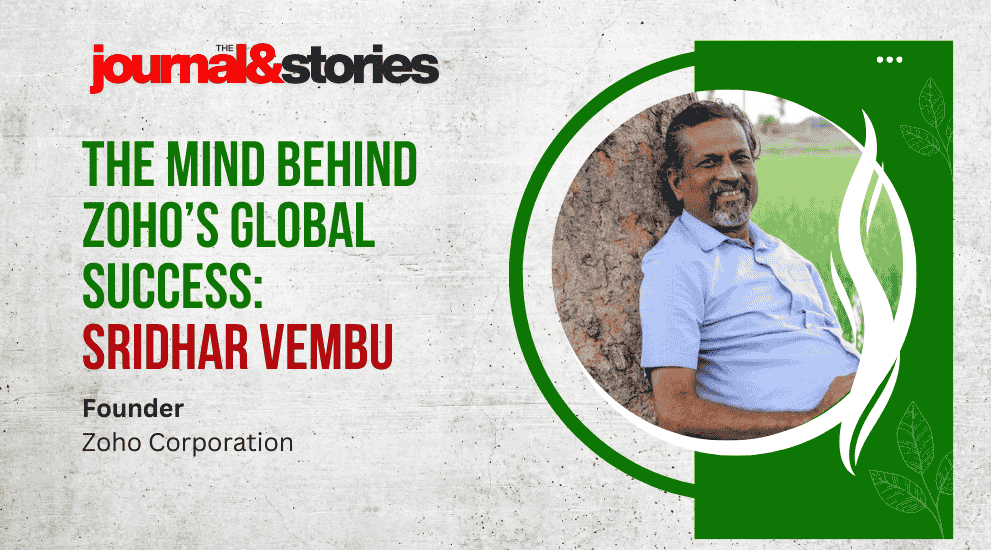
Sridhar Vembu is more than just an entrepreneur; he is also a visionary and a storyteller. He built a global IT powerhouse from the ground up in rural India. His personal story changes what it means to be successful in business and technology. Instead of following the usual paths to fame and fortune, his story is about going against the grain and building an empire based on new ideas, values, and a social purpose. Vembu’s story, from his humble beginnings in Tamil Nadu to making Zoho Corporation a huge global software company, inspires people all over the world who want to start their own businesses.
Sridhar Vembu was born in 1968 in Thanjavur, Tamil Nadu, India. He grew up in a place where both the promise of technology and the harsh realities of living in the country were real. His love of learning and natural curiosity finally led him to the Indian Institute of Technology (IIT) Madras, which is one of the best engineering schools in India. He got his bachelor’s degree in electrical engineering from that school. He was so smart in school that he was able to move to the United States and get a Ph.D. from Princeton University. In 1994, Vembu got his PhD and started working as a wireless engineer at Qualcomm in San Diego. He learned about new technologies and global markets in this job, but it also gave him the idea for something bigger: a goal of making important technology that comes from India.
The Beginning of a Vision: Sridhar Vembu was one of the people who helped start AdventNet, which later became Zoho. This was the first name for the business that would later become Zoho Corporation. AdventNet was the first big thing he did to become an entrepreneur. It started out as a small software development company that made network hardware and software. Vembu, his brothers and sisters, and his coworkers all worked hard to make a set of products that could compete on a global scale while still being flexible and focused on the user. In 2009, the company changed its name to Zoho Corporation and started focusing on Software as a Service (SaaS), which includes tools for improving efficiency, managing customer relationships (CRM), and working together. Zoho had a clear goal: to make a set of cloud-based software products that would help businesses of all sizes without the high costs that come with most corporate solutions.
Zoho didn’t get venture capital funding, even though it was thought to be important for success at the time. Instead, Sridhar Vembu chose to start the business from scratch. He used the money he made from sales to pay for development and put the rest back into the business. Because Zoho was so independent, it could stick to its long-term goal without being pushed by others to focus on short-term gains.
A New Kind of Workplace: Values Based on Education and People
Vembu’s people-first approach went beyond product strategy to include how Zoho hired and trained its employees. Vembu started Zoho Schools, an internal training program to teach students useful programming skills. He did this because he knew that just because someone had a degree from a university didn’t mean they were good at what they did. Zoho Schools started in 2004 and helps kids from all kinds of backgrounds. They care more about skills, curiosity, and passion than degrees.
This training program was more than just a way to hire new people; it was a social cause that changed how people think about hiring IT workers. The project helped a lot of students get jobs at Zoho even though they didn’t have college degrees. This shows that skills can be more important than diplomas if you have the right training and chance.
Coming Home: Bringing New Ideas to the Countryside
Sridhar Vembu made one of the most important decisions of his career in 2019 when he left Silicon Valley and moved back to Mathalamparai in Tenkasi, Tamil Nadu. Most IT CEOs wouldn’t have done this because they like to run their companies from big cities like Bangalore, San Francisco, or London. Vembu came up with a decentralized plan that would help rural areas grow technology and create good jobs. He believed that “talent is universal, opportunity is not,” and he wanted to show that you can make world-class software even if you don’t live in a big city with a lot of IT companies.
As Zoho opened offices in places like Tenkasi, Renigunta (Andhra Pradesh), and other semi-urban areas, they started to be more present in rural areas. Zoho didn’t make young people move to expensive places; instead, they gave them jobs where they were most needed. This plan worked in some places to make the economy stronger, but it also made workers more loyal and got people involved in their communities.
The Philosophy of Impact and Sustainability
Vembu’s values went beyond making money. He ran for office on a platform of building communities, living in a way that is good for the environment, and doing work that is good for people. Vembu’s life in rural India was hard, which was an example of the philosophy he believed in: that new ideas should be available to everyone, last a long time, and be based on real human needs. He wanted to hire more people at Zoho and make sure they did their jobs in a fair, healthy, and meaningful way.
It was a way to lead that combined coming up with new ideas with making the world a better place. People often talk about this style in management case studies and business thought leader forums.
Sridhar Vembu was in charge of Zoho’s rapid growth, which brought the company success and fame all over the world. The company now makes more than 50 apps that millions of people all over the world use and that compete with other companies all over the world. It was a success story for India and a global SaaS giant because it reached markets in the US, Europe, Asia, and Japan.
One of Zoho’s biggest successes was becoming a unicorn, which means it was worth more than $1 billion, even though it was fully funded by itself. Its yearly recurring sales shot up to amazing levels because customers were happy, the company made new products, and it stuck to a long-term strategic plan.
The Padma Shri was given to Sridhar Vembu by the Indian government in 2021 to honor his work in business, commerce, and industry. This is one of the highest awards for civilians in the country.
Sridhar Vembu was the CEO of Zoho for a long time. Now there are new leaders and goals for the future. He quit in January 2025 to take over as the company’s chief scientist. In this job, he worked on research, new ideas, and programs that help people in rural areas. He did this to help the company stay ahead of the curve in technology, especially in fields like artificial intelligence that are becoming more important. He also wanted to better support the company’s culture, which is important to his vision.
He is still in charge of research, which shows that you need more than just business sense to stay ahead in technology. You should also be interested in new things and think about the future.
Legacy: More Than Just Balance Sheets
Sridhar Vembu’s legacy is more than just billions of dollars or market values. People who went to Zoho Schools and got jobs there, people who live in rural areas and can’t find work, and a company that questions what everyone else thinks about where technology is made and who it serves all keep the spirit of Zoho Schools alive. His experience shows that success can mean something and be profitable, that true innovation can come from being independent from outside resources, and that the best use of technology might be to improve people’s lives, not just to shake up markets.