


























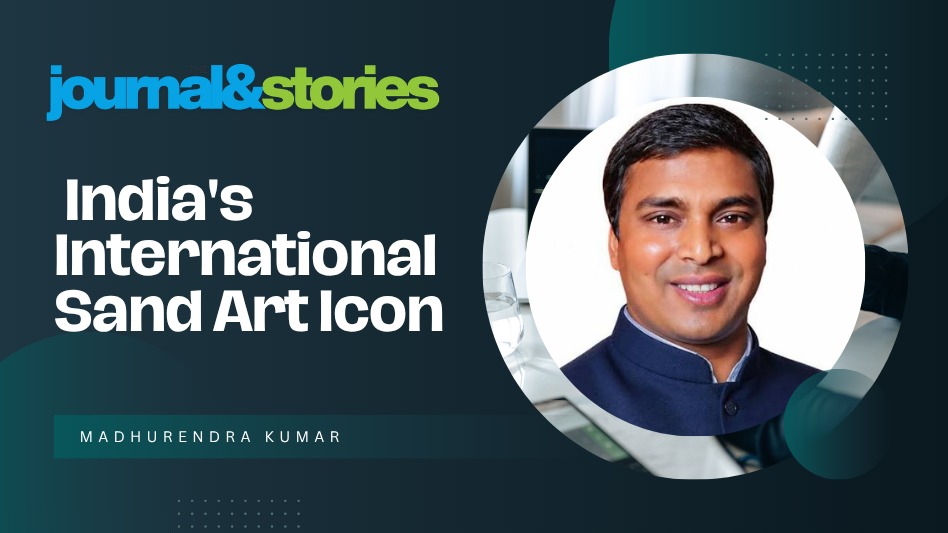












































































































































Madhurendra Kumar: The Indian Sand Artist Who Turned Grains of Sand into a Global Language of Hope.
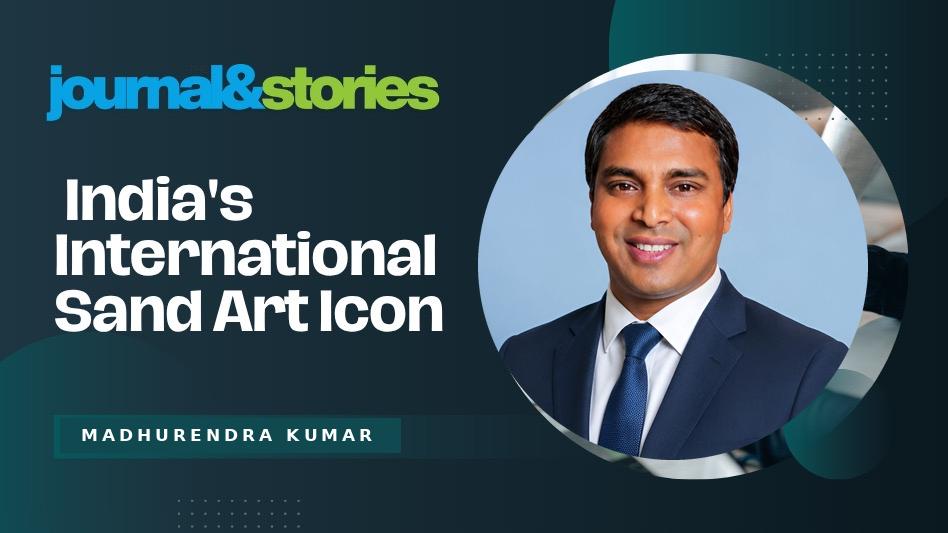

- From a humble farming family in Bihar to representing India in 25+ countries, Madhurendra Kumar transformed childhood struggles into an internationally celebrated artistic journey
- Using sand, leaves, recycled materials, and other mediums, he creates powerful artworks that promote environmental conservation, peace, social awareness, and positive change.
- Recipient of 100+ national and international honors, including an Honorary Doctorate (2026), he now dreams of establishing a free Sand Art Academy for underprivileged children.
Some artists paint on canvas, some carve masterpieces from stone, while a rare few transform the most fragile material on earth into timeless expressions of creativity. Madhurendra Kumar belongs to that extraordinary league of artists. With nothing more than grains of sand and an unstoppable passion, he has built a remarkable career that has carried the spirit of Indian art from the banks of a small river in Bihar to international platforms across the world.
Madhurendra Kumar: The Indian Sand Artist Who Turned Grains of Sand into a Global Language of Hope
Some artists paint on canvas, some carve masterpieces from stone, while a rare few transform the most fragile material on earth into timeless expressions of creativity. Madhurendra Kumar belongs to that extraordinary league of artists. With nothing more than grains of sand and an unstoppable passion, he has built a remarkable career that has carried the spirit of Indian art from the banks of a small river in Bihar to international platforms across the world.
Known as one of India’s internationally recognized sand artists and sculptors, Madhurendra Kumar has demonstrated that true talent does not depend on expensive studios, privileged backgrounds, or formal opportunities. His journey is one of resilience, determination, and unwavering faith in the power of art to inspire social change. Every sculpture he creates tells a story—not only of artistic brilliance but also of hope, humanity, and perseverance.
Humble Beginnings
Madhurendra Kumar was born on 5 September 1994 in Barwakala village, located in the Ghorasahan block of East Champaran district in Bihar, near the Indo-Nepal border. His ancestral village is Bijbani in Bankatwa block. He was born into a modest farming family where financial hardship was a part of everyday life. His father, Shivkumar Sah, worked as a farmer, while his mother, Gena Devi, devoted herself to managing the household.
Life was far from easy during his childhood. At an age when most children spent their days playing with toys, Madhurendra was helping support his family by grazing goats. Yet, those quiet hours beside the river became the foundation of his artistic journey. Surrounded by nature, he began shaping small figures and miniature houses from sand, unknowingly discovering the passion that would define his future.
As he grew older, economic challenges forced him to take on numerous jobs. He sold curd door to door, wove bamboo baskets, worked in hotels, sold vegetables and snacks at local fairs, and even painted houses to pay for his education. Despite these struggles, he never allowed poverty to diminish his dreams.
One of the most difficult periods of his life came during college when he was unable to pay his hostel fees. For nearly six months, he reportedly spent his nights sleeping in the college corridor. Rather than breaking his spirit, these hardships strengthened his determination to succeed.
A Gift Recognized Early
Madhurendra’s artistic ability was visible from an early age. At just three years old, he loved drawing birds and animals on the ground and on his slate. Watching his remarkable imagination unfold, his grandfather, the late Ramchandra Sah, predicted that the young boy would one day become a great artist.
Years later, that prediction proved remarkably accurate as Madhurendra earned recognition far beyond the borders of his home state.
Education Against All Odds
Although financial difficulties often threatened to interrupt his studies, Madhurendra remained committed to education. He completed his early schooling in his native village before pursuing higher education in fine arts.
He earned both a Bachelor of Fine Arts (BFA) and a Master of Fine Arts (MFA) in Sculpture from Mahatma Gandhi Kashi Vidyapith, Varanasi. In addition, he completed Intermediate, BFA, and MFA qualifications in Painting with First Division from Pracheen Kala Kendra, Chandigarh.
His academic journey reflects his belief that artistic talent flourishes best when combined with disciplined learning and continuous practice.
The Riverbank That Changed Everything
Unlike many artists who begin their careers in professional studios, Madhurendra’s first workshop was the sandy bank of the Aruna River, a tributary of the Bagmati River in Bihar. What began as childhood play gradually evolved into a serious artistic pursuit.
A defining milestone in his career came in December 2005 when he created a monumental sand sculpture titled “Sarvadharm Ki Shahadat – Dedicated to the Nation” in Bathinda, Punjab. Constructed with approximately 200 tons of sand over fifteen days with the assistance of fifty workers, the sculpture measured around 40 feet in height and 100 feet in length.
The artwork attracted widespread attention and appreciation. During the event, former President of India and renowned scientist Dr. A. P. J. Abdul Kalam admired the sculpture and encouraged the young artist, expressing confidence that the world would one day recognize his extraordinary talent.
Those words became a lifelong source of inspiration, motivating Madhurendra to pursue artistic excellence with even greater dedication.
Beyond Sand: A Multi-Media Artist
Although widely celebrated as a sand artist, Madhurendra’s creativity extends well beyond sand sculptures. Throughout his career, he has explored numerous artistic mediums, including clay, cement, metal, grains, leaves, fruits, and recycled materials.
His intricate leaf carving and fruit carving works demonstrate remarkable precision and patience. Every medium presents a new creative challenge, allowing him to continually reinvent his artistic expression while preserving his distinctive style.
This versatility has established him not merely as a sand sculptor but as a multidisciplinary visual artist.
Art with a Purpose
One of the defining characteristics of Madhurendra Kumar’s work is its social relevance. Rather than creating sculptures solely for aesthetic appreciation, he uses art as a powerful medium for public awareness.
His installations frequently address issues such as environmental conservation, climate change, water preservation, anti-drug campaigns, plastic pollution, sanitation, women’s empowerment, global peace, and opposition to terrorism.
By transforming these important messages into visually striking sculptures, he succeeds in engaging audiences emotionally while encouraging meaningful conversations about society’s most pressing challenges.
His philosophy is simple yet powerful: art should not only decorate spaces but also inspire positive change.
Innovation Through Recycling
Among Madhurendra’s most distinctive contributions is his innovative use of waste materials. Empty liquor bottles, tobacco sachets, cigarette butts, and discarded plastic have all found new life in his installations.
Instead of viewing waste as garbage, he transforms it into thought-provoking artworks, including human skeletons and symbolic sculptures that warn against addiction and environmental destruction.
These unconventional creations have received widespread appreciation for combining artistic creativity with strong social messaging.
Representing India Across the World
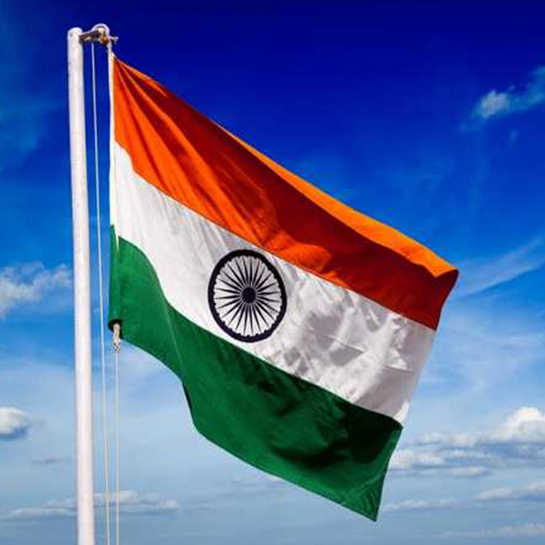
Over the years, Madhurendra Kumar has represented India in more than twenty-five countries, including the United States, the United Kingdom, Germany, France, China, Japan, Russia, Italy, Australia, and several others.
He has participated in more than fifty international sand art festivals, where his sculptures have introduced global audiences to Indian culture, spirituality, history, and social values.
His work demonstrates that Indian contemporary art can successfully combine traditional storytelling with modern environmental and humanitarian themes.
World Records and International Recognition
Madhurendra’s artistic excellence has earned recognition through numerous world records and international honors for his exceptional contributions to sand art, leaf art, and socially themed public installations.
His large-scale artistic projects, innovative techniques, and commitment to public awareness have distinguished him as one of the most prolific contemporary sand artists from India.
Throughout his career, he has received more than one hundred national and international awards, reflecting both artistic achievement and social impact.
Ambassador for Social Causes
Recognizing the influence of his art, various government agencies and organizations have invited Madhurendra Kumar to serve as the face of important public awareness campaigns.
His artistic creations have supported voter awareness initiatives, cleanliness drives, environmental campaigns, and farmer empowerment programs. Because sand sculptures naturally attract public attention, they have become highly effective tools for communicating civic messages to diverse audiences.
Through these collaborations, Madhurendra has demonstrated that artists can play a meaningful role in public education and nation-building.
Honorary Doctorate and Global Appreciation
In recognition of his outstanding contribution to the field of sand art, Madhurendra Kumar was awarded an Honorary Doctorate by America International University (AIU), Hollywood, in 2026.
This honor acknowledged not only his artistic excellence but also his commitment to using creativity as a force for education, awareness, and positive social transformation.
A Vision for the Future
Despite his remarkable success, Madhurendra remains deeply connected to his roots. His long-term dream is to establish a free Sand Art Academy for talented children from economically disadvantaged backgrounds.
Having personally experienced financial hardship, he understands how many gifted young artists are forced to abandon their dreams simply because they lack resources. Through this academy, he hopes to provide opportunities that he himself never had.
He also plans to develop innovative combinations of 3D sand art and leaf art while promoting India’s rich folk traditions on global artistic platforms.
For Madhurendra, success is not measured solely by awards or records but by the ability to inspire the next generation of artists.
Conclusion
Madhurendra Kumar’s life is a remarkable testament to the transformative power of determination, imagination, and hard work. From grazing goats along a quiet riverbank in Bihar to representing India on prestigious international stages, his journey proves that extraordinary dreams can emerge from the most ordinary circumstances.
His sculptures may be temporary, shaped by fragile grains of sand, but the messages they carry leave lasting impressions. They remind us to care for our planet, value peace, reject addiction, celebrate humanity, and believe in the limitless potential of creativity.
Today, Madhurendra Kumar stands not only as an internationally acclaimed Indian sand artist but also as an inspiring symbol of perseverance. His story encourages countless young dreamers to believe that no obstacle is too great when passion is stronger than circumstance.
In every grain of sand he shapes, Madhurendra leaves behind something far more enduring than a sculpture—he leaves behind hope, inspiration, and the belief that art has the power to change both lives and society.