




































































































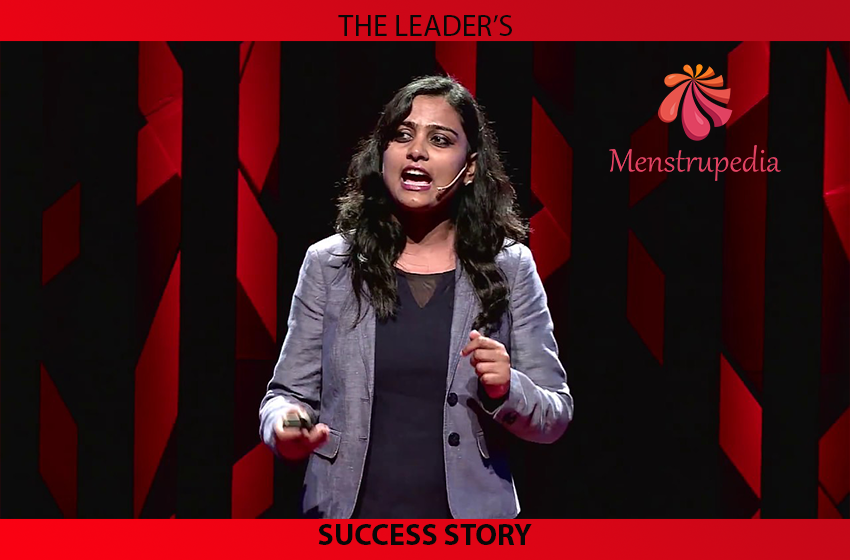











































































































































Aakriti Srivastava: The Visionary Reimagining India’s Desert Economy.
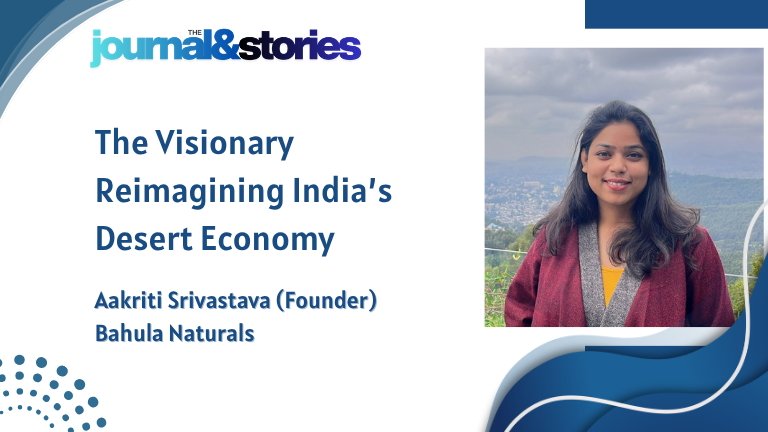

- Aakriti Srivastava transformed a journalism assignment into Bahula Naturals, building a purpose-driven enterprise that empowers pastoral communities while preserving Rajasthan’s indigenous heritage.
- By reviving camel milk and creating sustainable value chains, Bahula Naturals has generated livelihoods, strengthened women-led entrepreneurship, and redefined the future of India’s desert economy.
- Rooted in empathy, climate resilience, and community ownership, Aakriti’s vision proves that meaningful businesses can create lasting social impact alongside commercial success.
Founder of Bahula Naturals, she didn’t just start yet another food startup. She has built a purpose driven enterprise that connects sustainability, traditional wisdom, climate resilience, rural livelihoods and premium nutrition into one powerful vision. Many companies chase profits, but Bahula Naturals proves that good impact and business success can grow together.
A Journey Started with Curiosity
Every entrepreneur has their moment.
That moment came for Aakriti when she visited Bajju, a remote village in the Thar Desert of Rajasthan. She was studying journalism and documentary filmmaking at the time, travelling across India to understand social and environmental challenges. What was supposed to be just another reporting assignment slowly became a life changing experience.
She travelled deeper into the desert and found communities living in extremely difficult conditions. There was hardly any water. Temperatures didn’t show any mercy. Markets were far away. Livelihood opportunities were going away.
But in the midst of these difficulties, she saw great resilience.
The pastoral families had preserved the indigenous knowledge for centuries. Their relationship with camels, local cattle, land and nature was a sustainable lifestyle that modern development has largely ignored.
Instead of repeating her struggles and moving on, Aakriti asked herself a different question:
“What if entrepreneurship was the bridge between these communities and the modern marketplace?”
One simple question led to the creation of Bahula Naturals. ([YourStory.com][1])
More than a Dairy Brand
Bahula Naturals appears to be a premium food company selling camel milk products, artisanal cheeses, cold-pressed oils, black wheat flour and other naturally produced foods.
But its real identity is much deeper than this.
The company is a community-owned model where value is created with the very people who produce it. Bahula does not regard farmers and herders as suppliers but as partners in a common ecosystem.
The company works with thousands of pastoral households across Rajasthan, combining traditional livestock practices with modern quality standards to create authentic products that meet the expectations of the modern consumer. ([YourStory.com][1])
Recovery of a Lost Treasure
One of Bahula Naturals’ most remarkable achievements has been its work to revive camel milk.
For generations, camels were an identity of Rajasthan. But as lifestyles changed and commercial demand declined, the numbers of camels fell rapidly, threatening not just an animal but an entire way of life.
Aakriti knew that conservation couldn’t be run on emotion alone.
Communities protect what they live on.
By creating premium value chains around camel milk and developing innovative products such as artisanal cheeses and nutraceuticals, Bahula Naturals turned camel milk from an overlooked resource into a valuable economic opportunity.
This market-oriented approach has helped to restore confidence among pastoral families while conserving one of India’s most distinct ecological assets. ([YourStory.com][1])
Women at the Heart of Change
Aakriti’s leadership is inspiring for many reasons, not least her commitment to women.
During her years living with pastoral communities, she noticed that women were responsible for most of the daily tasks relating to livestock management. They looked after the animals, looked after the home, looked after the milk production and ran the businesses.
But the financial control was usually elsewhere.
Rather than accept this as tradition, Bahula Naturals put in place systems that sent payments for milk directly to women’s bank accounts.
The results went far beyond financial inclusion.
Women got stronger.
Families spent more on education.
Young girls began dreaming of jobs that were once unattainable.
Economic participation was a kind of personal empowerment.
For Aakriti, sustainability has never been about preserving the environment. It also means creating dignity, opportunity and independence for every person in the value chain. (YourStory.com[1])
Creating Sustainability from Scratch
Climate change is no longer a future worry.
It’s a daily reality for rural communities.
Keeping this in mind, Bahula Naturals has incorporated eco-friendly practices across the board. Its business philosophy rests on renewable energy, climate-resilient agriculture, indigenous livestock and low-impact food systems.
Instead of importing solutions, the company taps into the knowledge that desert communities have developed over centuries.
This mix of traditional knowledge and modern innovation is a practical blueprint for sustainable development in climate sensitive regions. ([Hindustan Times][2])
Entrepreneurship based on Empathy
Scaling is a topic many startup founders discuss.
Aakriti talks about listening.
She didn’t come to Rajasthan with a readymade business model but spent years understanding the ground realities before starting her enterprise.
That patience became one of Bahula Naturals’ biggest competitive advantages.
Solutions were not forced by the company.
It co-authored them.
This spirit of collaboration built trust between communities that had been historically marginalized from mainstream markets.
It also illustrates why Bahula has become much more than a commercial undertaking.
It has become a movement based on participation, not extraction.
Rethinking Success
Traditional business metrics are based on revenue, valuation and market share.
At Bahula Naturals, we define success differently.
- Each family with a steady income
- All women become financially independent
- Every camel saved through sustainable livelihoods
- To all the young professionals in the country who choose to stay in their community rather than leave
These achievements are types of wealth that are seldom shown up on financial statements, but have long-term social value.
Meanwhile, Bahula is continuing to grow its premium food portfolio via B2B partnerships, direct-to-consumer sales, experiential retail and international exports, showing that purpose-led businesses can compete effectively in today’s markets. ([YourStory.com][1])
New Generation of Leaders
It is not only her entrepreneurial skills but also her definition of leadership that makes Aakriti Srivastava stand out.
She’s one of a wave of entrepreneurs who think businesses should address meaningful problems, rather than just look for profitable markets.
Her journey from journalist to social entrepreneur is a testament to the power of curiosity, courage and conviction.
She wasn’t asking how to build the next unicorn, but how to build an ecosystem where communities, consumers and nature could all thrive together.
That philosophy has become the greatest competitive advantage for Bahula Naturals.
The Road Ahead
Bahula Naturals continues to grow, nationally and internationally, but its mission has remained remarkably consistent: to reconnect consumers with real food and build stronger communities for the people who make it.
The company’s vision is not just about products.
It attempts to reimagine India’s approach to agriculture, pastoralism, climate resilience and rural entrepreneurship.
For Aakriti Srivastava, every bottle of milk, every wheel of artisanal cheese and every naturally produced food item has a deeper story – a story of resilience, dignity, and collective progress.
In a world where success is often measured by speed, Bahula Naturals reminds us that lasting impact is made slowly, one relationship, one community, and one meaningful decision at a time.
Perhaps that is the greatest lesson from Aakriti’s journey.
Sometimes, the future doesn’t start in skyscrapers or boardrooms.
It can start in the desert, in the quiet center of the sands. One entrepreneur decided to believe that the strength of tomorrow lay in the traditions of the past.