







































































































































































































Tessa Cook: The Founder Who Turned Food Waste into a Global Movement.
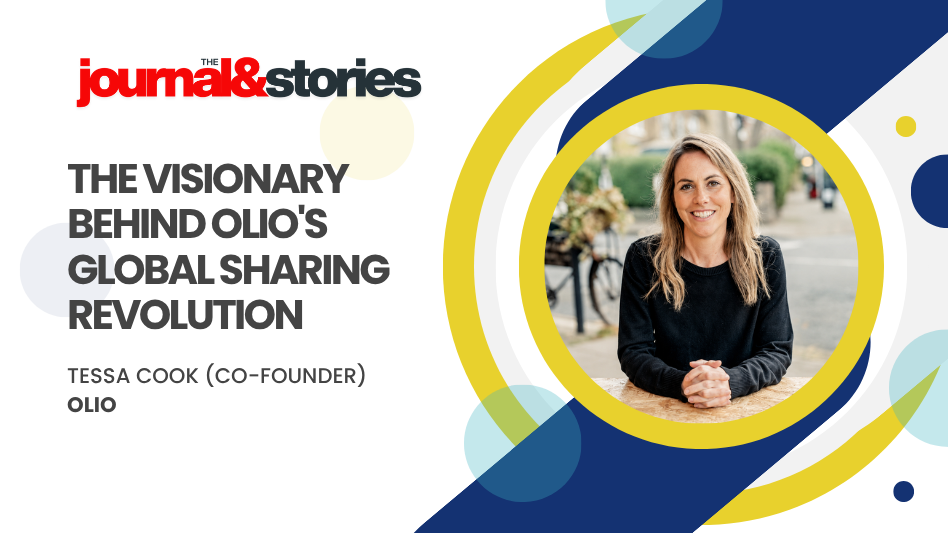

- One simple observation about food waste became the foundation of OLIO, proving that the world’s biggest innovations often begin with everyday problems that others choose to ignore.
- Tessa Cook’s journey reminds us that resilience is the true currency of entrepreneurship. Every rejection became another step toward building one of the world’s most impactful sustainability platforms.
- OLIO is more than a food-sharing app—it is a global community built on generosity, sustainability, and the belief that small acts of sharing can create extraordinary social and environmental change.
In entrepreneurship, some founders start enterprises to solve business problems; others create companies that challenge the way society thinks. Tessa Cook is one of the second type. As co-founder of OLIO she has taken a simple observation and turned it into a global movement that is transforming the way millions of people think about food, waste and community.
It wasn’t an overnight success story. It is a path of curiosity, resilience, rejection upon rejection and a firm belief that little things, multiplied by millions, may make tremendous change. Today OLIO is one of the world’s largest sharing platforms, connecting up neighbors and businesses to exchange extra food and home products instead of wasting them.
Behind this incredible feat is a woman who refused to accept the adage, “That’s just the way things are.” The Inspiration Behind the Idea
Big enterprises frequently begin as an everyday problem that most people don’t notice. For Tessa Cook, that moment came as she was assisting her family in moving back from Switzerland to the United Kingdom.
The family had perfectly delicious meals that they couldn’t take with them when it was time to go. It seemed awful to throw it out, but there was no easy way to offer it to somebody nearby who could use it. The event revealed an unexpected gap in modern culture.
People lived closer together than ever before, but sharing resources with neighbors turned out to be ridiculously difficult.
That realization stuck with Tessa.
Instead of accepting food waste as an unavoidable fact of life, she started to ask a different question:
What if technology could help communities rebuild themselves and make sharing as easy as sending a text message?
That one query was the seed of OLIO. Developing the Right Skills in a Career
Before starting OLIO, Tessa already had a substantial corporate career.
She attended the University of Cambridge then received an MBA from Stanford Graduate School of Business, one of the world’s leading institutes for entrepreneurs and business leaders.
She has professional experience from firms like McKinsey & Company and then several years in large international enterprises, gaining knowledge in strategy, operations, leadership and addressing difficult business problems.
Those jobs gave her financial security and professional progress, but they also taught her an equally crucial lesson – big problems need big answers.
Tessa began to see entrepreneurship not just as a means to make money but also as a solution to address environmental and social concerns.
That mentality will influence every move she made later. ## Making OLIO with Saasha Celestial-One
Great ideas are not enough to make a startup profitable. It requires the appropriate relationship.
Tessa teamed hands with her long-time friend, Saasha Celestial-One, who shared her passion for sustainability. Instead they decided to establish a platform for neighbors to share excess food rather than tossing it out.
The premise seemed easy enough.
Someone with extra groceries may post a picture.
Someone nearby who needed those may come and get them.
No money would be exchanged.
Food would get saved.
Communities would grow stronger.
The concept was simple, but convincing investors that total strangers would happily share food with each other was a far tougher sell.
Many thought people would never trust the site.
Others wondered whether users would come back regularly.
Some questioned if there was even a true market for this proposal.
Tessa and Saasha stayed on board, but they were skeptical.
They knew that fixing food waste was not simply about building technology, it was about changing habits. ### Grit in the face of rejection
Like many businesses, Tessa’s journey was littered with obstacles.
Investors continually rejected the idea.
A few meetings lasted only a few minutes.
Others questioned whether the creators were trying to construct a charity, not a scalable business.
One of the main problems in OLIO’s early days was raising funds.
But the rejections only made them more determined.
instead didn’t give up on the idea, but instead developed their product, improved the experience for users, listened to comments, and kept showing the expanding influence of the platform.
This tenacity was one of Tessa’s defining attributes.
She constantly stresses that resilience is one of the most significant traits that an entrepreneur can have.
Success rarely comes to the man who has not failed.
It belongs to the ones who never give up. ## Addressing One of the World’s Biggest Challenges
Food waste is far more than an environmental problem.
It has implications for climate change, natural resources, household budgets and world hunger.
Every year, millions of tonnes of food fit for consumption is wasted while millions of people go hungry.
Food production consumes large amounts of water, energy and land, and labour.
All those resources are wasted when that food ends up in landfill.
Tessa knew that reducing food waste was one of the easiest and quickest ways people could cut down their environmental footprint.
She thought that ordinary people could be part of the solution, instead of waiting for governments or big institutions to solve the problem.
That philosophy was the core of OLIO.
Each shared meal, loaf of bread, fruit basket, or homemade dish was a small but meaningful victory against waste. ## Not Just a Food-Sharing App
OLIO, over time, grew naturally beyond sharing food alone.
The platform expanded to household goods, clothes, books, toys, furniture and countless everyday items people no longer wanted.
Instead of chucking good stuff in the bin, people could give it to someone close by.
The change backed the growing circular economy, where products are kept in use for as long as possible, rather than becoming waste.
The app gradually grew to be much more than just technology.
It became a community centered on generosity.
Neighbors who had never spoken before began meeting.
Families found affordable essentials.
Students furnished apartments.
Parents traded children’s outfits.
Local communities got stronger via simple acts of sharing. ## Creating Business Impact Alongside Social Impact
One of Tessa Cook’s biggest triumphs has been establishing that meaning and profitability can coexist.
OLIO partnered with supermarkets, restaurants, cafés, bakeries, and food retailers to redistribute surplus food that would otherwise be discarded.
Businesses gained from decreasing disposal expenses, enhancing sustainability initiatives, and establishing community partnerships.
Consumers gained access to perfectly good food.
The environment benefited from reduced garbage.
This created a business model where every stakeholder gained value.
Rather than approaching sustainability as a marketing campaign, OLIO integrated it into the company’s basic operations.
This strategy has motivated many entrepreneurs to rethink how enterprises might provide both financial rewards and excellent society benefits. ## Leadership Through Purpose
Tessa’s leadership style contrasts from the cliché of aggressive company founders pushing rapid growth at any cost.
She continually emphasizes mission over ego.
Her focus remains on developing a culture where employees understand the wider purpose underlying their work.
Purpose-driven organizations often inspire more engagement because people believe they are contributing to something worthwhile.
For Tessa, every employee, volunteer, business partner, and user plays a role in decreasing waste and establishing stronger communities.
This shared objective has enabled OLIO establish an active worldwide network rather than simply a consumer base. ## Inspiring the Next Generation of Entrepreneurs
Tessa frequently speaks about entrepreneurship, sustainability, and leadership at conferences and universities.
One message appears regularly throughout her talks:
You do not need authorization to address a problem.
Many ambitious entrepreneurs spend years waiting for the perfect chance, optimum cash, or complete certainty.
Tessa’s experience indicates that lasting change frequently begins with identifying a problem that genuinely matters and taking the first imperfect step toward solving it.
Her tale reminds creators that innovation is not necessarily about inventing wholly new technology.
Sometimes, it is about harnessing existing technology to reconnect people in better ways. ## What Business Leaders Can Learn
Tessa Cook’s entrepreneurial path has some useful lessons tucked away.
Solve real problems, not trends. Companies that are founded around real human needs are much more likely to have a lasting effect.
Second, it’s better to be persistent than perfect. All successful companies experience rejection, uncertainty and failure. The difference is being able to push through such difficulties.
Third, develop communities, not just clients. People stay loyal to brands that reflect their values and generate meaningful experiences.
Fourth, purpose can be a competitive advantage. Today’s consumers are more and more supportive of firms that produce exceptional products and services and make a constructive contribution to society.
Finally, success should not be judged only in revenue. True success also means environmental effect, social worth, and lives made better along the way. ## Looking Toward the Future
The worldwide discourse around sustainability continues to develop, and companies like OLIO are becoming increasingly relevant.
As populations grow and environmental issues become more severe waste reduction will continue to be one of the most significant concerns for governments, businesses and individuals.
Tessa Cook has more on her mind than just developing a great technology company.
She imagines a world where sharing is a way of life, where perfectly good food is never wasted simply because it is surplus, and where communities rediscover the joy of assisting each other.
It’s a big aim, but OLIO has already shown that substantial change can start with millions of little, everyday activities. ## TL;DR
Tessa Cook’s business path is a poignant reminder that some of the world’s biggest potential are concealed behind its biggest issues. What began as a frustration with throwing away perfectly fine food has since become a platform that has motivated communities in several nations to re-think consumption, generosity and sustainability.
Her success is not just measured in downloads, partnerships or business development. It’s in every meal recovered from the landfill, every family supported via sharing what we have, and every community made stronger through acts of simple compassion.
In an era where technology may sometimes isolate us from each other, innovation has been harnessed by Tessa Cook to bring communities together. Her tale is proof of the fact that entrepreneurship is not just about earning income, but creating value for the society.
And when future generations seek out methods to develop enterprises with purpose, Tessa Cook’s journey will be a powerful example of how dedication, empathy, and a simple idea can start a movement that can change the world.