





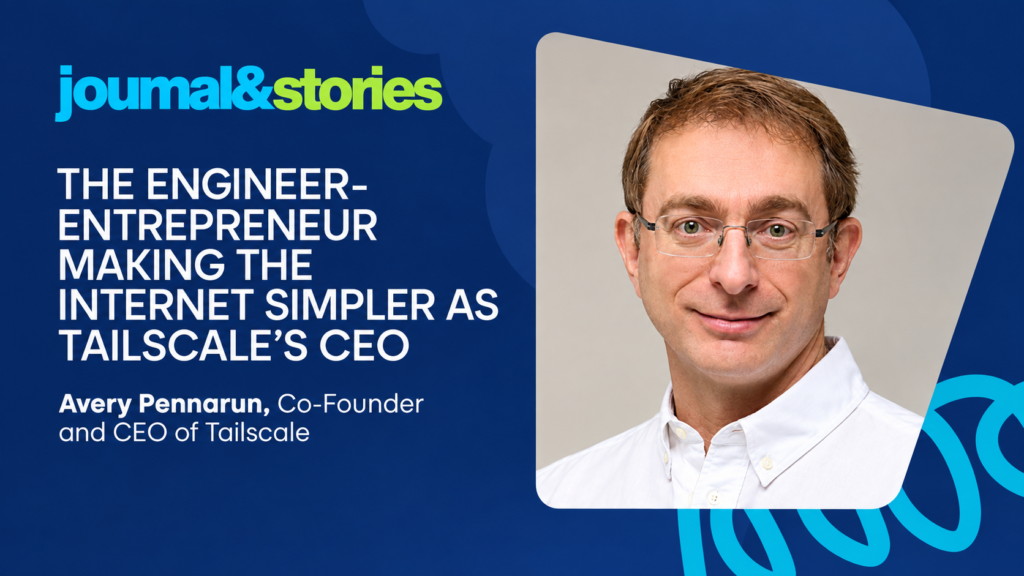


































































































































































































































Avery Pennarun: The Engineer-Entrepreneur Making the Internet Simpler as Tailscale’s CEO.
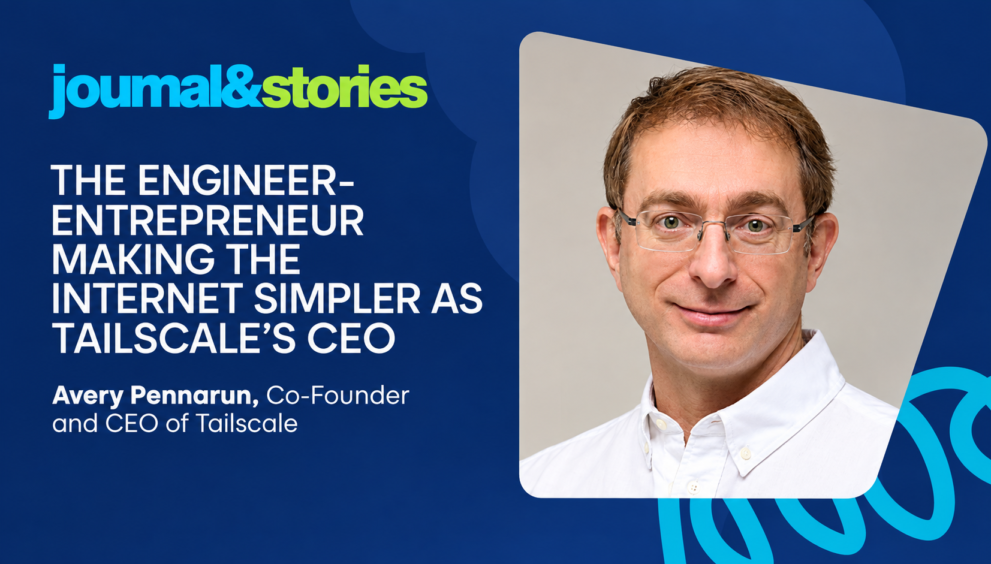

- Avery Pennarun transformed his passion for engineering into entrepreneurship, eventually co-founding Tailscale to simplify secure networking. His journey shows how technical curiosity can become the foundation for building impactful technology
- As CEO of Tailscale, Pennarun is challenging traditional approaches to networking, security, and connectivity.
His vision focuses on making complex infrastructure simpler, safer, and easier for businesses to use. - From experimenting with Linux to leading a rapidly growing technology company, Pennarun’s career reflects innovation and persistence. Through Tailscale, he continues exploring how modern networking can evolve alongside cloud computing and AI.
In technology, complexity is often treated as a sign of sophistication. But Avery Pennarun, Co-Founder and CEO of Tailscale, has built much of his career around the opposite idea. For him, the best technology is not necessarily the technology users notice. It is the technology that quietly solves difficult problems while making life easier for the people using it.
That philosophy has shaped Pennarun’s journey from a technically curious teenager in Canada to an experienced software engineer, entrepreneur, and the leader of Tailscale, a company working to rethink how devices, applications, and people securely connect over the internet.
A Childhood Curiosity That Became a Career
Pennarun’s relationship with technology started well before he became a CEO.
Growing up in Thunder Bay, Ontario, he became interested in computers and networking at a young age. One of the earliest stories from his journey involves sharing a dial-up internet connection with his sister. What began as a practical problem eventually became an opportunity to explore how computers communicate with one another.
As a teenager, Pennarun experimented with Linux and even worked on network drivers for older hardware. His curiosity was not limited to simply using technology; he wanted to understand what was happening underneath the surface.
That mindset became an important part of his professional identity.
Rather than accepting complicated systems as unavoidable, Pennarun developed a habit of asking a straightforward question: Can this be made simpler?
That question would eventually become central to Tailscale.
From Engineering to Entrepreneurship
Pennarun’s career was not built entirely inside large technology companies.
While studying at the University of Waterloo, he became involved in building software and networking solutions. He later founded Net Integration Technologies, a company that developed technology for small businesses. The company eventually became part of IBM in 2008.
The experience gave Pennarun something that technical education alone could not provide: a practical understanding of what it takes to build a product, find customers, make difficult business decisions, and learn from mistakes.
His entrepreneurial experience also influenced how he thought about technology adoption.
A technically impressive product is not automatically a successful product. Customers have to understand it, trust it, and find it useful enough to change their existing habits.
That lesson would become especially important when Pennarun later helped build Tailscale.
The Google Years and the Problem of Too Much Complexity
Before Tailscale, Pennarun spent around seven and a half years at Google.
Working at a company operating at enormous scale gave him valuable exposure to large distributed systems and infrastructure. But it also showed him something that would later influence his startup philosophy.
Not every company needs Google-level infrastructure.
Pennarun noticed that many technology teams were adopting ideas designed for massive internet-scale systems even when their own requirements were much smaller. The result could be unnecessary complexity, more operational work, and slower development.
This observation influenced the very name Tailscale.
The idea was almost deliberately opposite to “internet scale.” Instead of starting with the assumption that every problem needs enormous infrastructure, Pennarun wanted to focus on the long tail of everyday networking problems that still deserve elegant solutions.
It was a surprisingly simple idea, but one with significant consequences.
Why Tailscale Was Created
The roots of Tailscale came from a practical security problem.
Pennarun had encountered situations where organizations needed secure access to servers and systems without having to redesign their entire infrastructure. Traditional VPN systems could be complicated to configure and maintain, while security requirements were becoming increasingly demanding.
The basic question was simple:
What if secure networking could just work?
That thinking helped lead to Tailscale.
The company’s approach was to make connecting devices easier by combining networking with identity and encryption. Instead of asking users to become networking experts, Tailscale aimed to handle much of the difficult work behind the scenes.
The product eventually became known for allowing devices and services to communicate securely without forcing teams to manage the same layers of networking complexity associated with traditional approaches.
Building a Product People Actually Want to Use
One of Pennarun’s strongest ideas as a technology leader is that security should not have to fight against usability.
In many organizations, security systems can become obstacles. Employees need access to resources, developers need to move quickly, and IT teams need to maintain control. When security becomes too difficult, people often search for workarounds.
Tailscale attempts to reverse that dynamic.
The goal is to make the secure option the easy option.
Pennarun has described the company’s approach as connecting devices with encryption, identity, and firewalling handled automatically. That philosophy is important because it changes the role of security from something users constantly have to think about into something that becomes part of the infrastructure itself.
This is also where Pennarun’s engineering background becomes visible in his leadership style.
He tends to approach business problems much like technical problems: understand the system, identify unnecessary complexity, and remove what does not need to be there.
From Startup Experiment to Major Technology Company
Tailscale began relatively quietly.
Its early growth demonstrated something particularly valuable in the technology world: people were willing to recommend the product to one another because they found it useful.
The company’s early launch received significant attention from the developer community, and Pennarun became deeply involved with users and their feedback.
That product-led approach helped Tailscale grow.
By March 2025, Stratechery reported that Tailscale had surpassed 10,000 business customers and had more than 500,000 weekly active users, with a total active user base in the millions.
The company also raised significant venture funding as it expanded. In 2025, Tailscale announced a $160 million Series C round, backed by investors including Accel, CRV, Insight Partners, Uncork Capital, and Heavybit.
For Pennarun, however, growth is not simply about becoming bigger.
The challenge is growing while preserving the simplicity that made the product attractive in the first place.
A Different Kind of CEO
Pennarun does not fit the traditional image of a technology CEO who completely separates himself from engineering.
His technical background remains an important part of how he approaches leadership.
He has acknowledged that he does not code as much as he once did, but he still describes his work as solving problems with an engineer’s mindset. Whether he is examining a database, working with employees, or thinking through product decisions, the underlying approach remains similar.
That perspective can be valuable in a technical company.
Instead of viewing engineering and business as completely separate worlds, Pennarun appears to treat them as interconnected parts of the same system.
The result is a leadership style centered around curiosity, simplicity, and responsibility.
The New Internet
Pennarun’s vision for Tailscale has also expanded beyond simply building a better VPN.
In his writing about the company’s future, he has described a broader ambition around creating a “new internet” where connecting systems can become easier and more natural.
The idea reflects a fundamental change in how modern organizations operate.
Companies now have employees working from different locations, applications spread across cloud providers, devices operating outside traditional corporate networks, and increasingly sophisticated automated systems.
The old idea of a secure corporate network with a clear inside and outside is becoming harder to maintain.
That makes identity-based and software-defined networking increasingly important.
For Pennarun, the opportunity is not simply to add another security product to an already crowded technology stack. It is to make secure connectivity feel almost invisible.
Tailscale and the Rise of AI
Artificial intelligence is creating another important chapter in Tailscale’s story.
As AI systems and agents become capable of interacting with data, applications, and infrastructure, secure connectivity becomes more complicated. An AI system that can take action needs controlled access to the resources it is allowed to use.
This creates a new challenge for security teams.
In 2025 and 2026, Pennarun has increasingly discussed how networking and identity can help organizations manage AI-related infrastructure securely. Tailscale has also been positioning itself to support AI teams and emerging agent-based workflows.
This evolution shows that Pennarun’s original philosophy remains relevant.
The technology around us keeps changing, but the underlying problem stays familiar: how can we make complicated systems easier and safer to use?
The Leadership Lesson Behind Avery Pennarun’s Journey
Perhaps the most interesting part of Pennarun’s story is that his success did not come from abandoning his engineering roots.
Instead, he turned those roots into a leadership advantage.
His journey demonstrates that deep technical knowledge and entrepreneurship do not have to exist separately. An engineer can become a CEO without losing the curiosity that made them an engineer in the first place.
Pennarun’s career also highlights another important lesson: simplicity can be a competitive advantage.
In an industry where companies often compete by adding features, tools, dashboards, and layers of functionality, Tailscale has built much of its identity around removing friction.
That is not necessarily easy.
Making something simple for the customer often means solving extremely complicated problems behind the scenes.
Looking Ahead
Avery Pennarun’s journey is still evolving.
From a teenager experimenting with Linux and networking to the CEO of a fast-growing technology company, his career has followed one consistent thread: the desire to make difficult technology easier to understand and use.
Tailscale’s growth suggests that this philosophy has found a significant audience.
As cloud computing, distributed work, cybersecurity, and artificial intelligence continue to reshape the technology landscape, secure connectivity will become even more important. Pennarun’s challenge will be to help Tailscale grow without allowing the complexity of the industry to undermine the simplicity that made the company different in the first place.
That may ultimately be Avery Pennarun’s biggest contribution—not simply creating another networking company, but showing that sophisticated infrastructure does not have to feel sophisticated to the people who depend on it.
In a world where technology keeps becoming more complicated, Pennarun is betting on a surprisingly powerful idea: the best technology is the technology that gets out of your way.

