



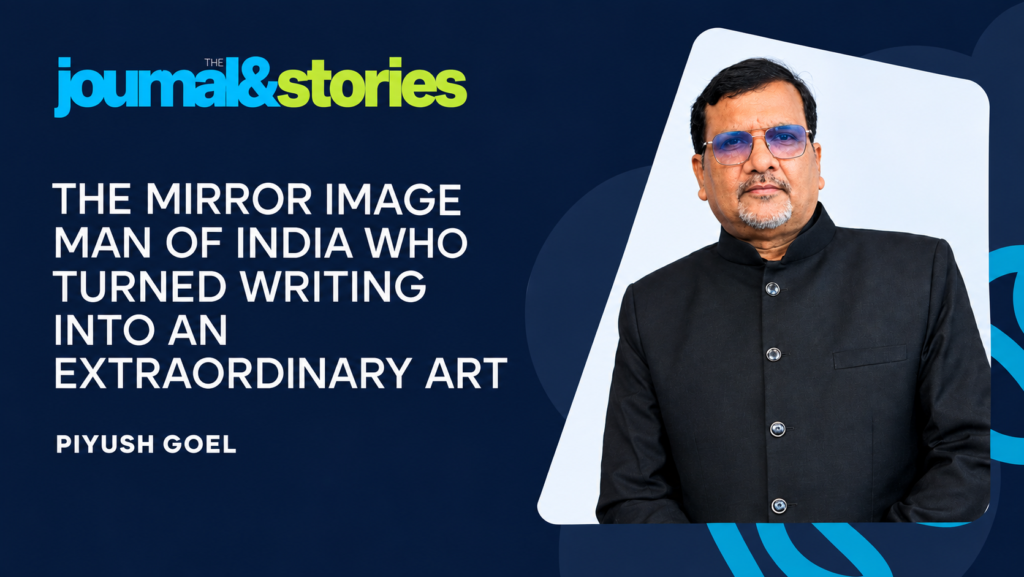













































































































































Piyush Goel: The Mirror Image Man of India Who Turned Writing into an Extraordinary Art.
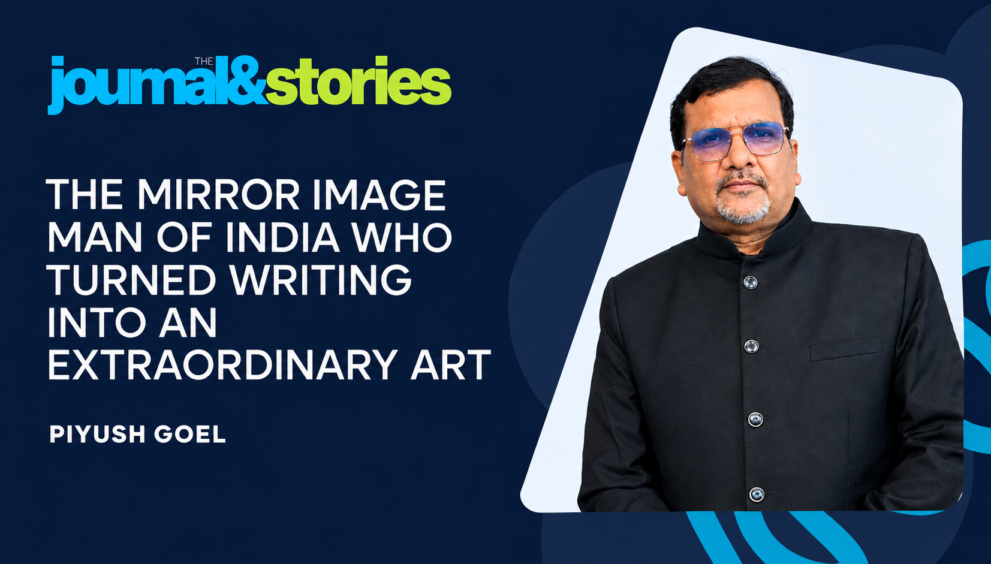

- Piyush Goel has transformed mirror-image writing into a remarkable form of art, creating handwritten works that challenge the way we traditionally read and write.
- From needles and mehndi cones to iron nails, Goel uses unconventional tools to write, turning patience, creativity, and experimentation into his signature craft.
- Known as the “Mirror Image Man of India,” his journey goes beyond unique handwriting, inspiring people to look at creativity, persistence, and possibilities from a different angle.
There are people who write books, and then there are people who completely change the way we think about writing. Piyush Goel, popularly known as the “Mirror Image Man of India,” belongs to the second category.
At a time when writing has largely moved from notebooks to keyboards and screens, Goel has chosen a remarkably different path. He has spent years creating books by hand in mirror-image writing, sometimes using ordinary writing instruments and, at other times, objects that most people would never imagine using for literature.
From Mechanical Engineering to an Unusual Literary Journey
Piyush Goel’s professional background is quite different from what one might expect from a person associated with handwritten literature. He has a Diploma in Mechanical Engineering, along with qualifications in Material Management and Vastu Shastra.
But alongside his professional life, he developed a completely different passion—the art of writing in reverse or mirror image.
According to profiles about his journey, the idea developed over many years. A significant turning point came around 2000, when Goel met with an accident. During his recovery period, he continued reading the Shrimad Bhagavad Gita. This period of reflection eventually encouraged him to think about doing something unusual with writing.
Rather than allowing a difficult phase to slow him down, he turned his attention toward experimentation.
That decision eventually became the foundation of a unique identity.
What Exactly Is Mirror-Image Writing?
Mirror-image writing is essentially writing in reverse so that the words appear correctly when viewed through a mirror.
For most people, writing normally is automatic. The hand moves in a familiar direction, letters follow a learned pattern and the brain does not have to consciously think about every stroke.
For Goel, however, the process involves reversing that familiar system.
Imagine writing hundreds of pages while constantly thinking about how each letter should appear in reverse. Now imagine doing that not just once, but across complete books.
That is what makes his work fascinating.
His mirror-image books require readers to use a mirror to see the writing normally. His work with the Shrimad Bhagavad Gita became one of the most recognised examples of this unusual approach. He wrote all 18 chapters and 700 verses in both Hindi and English in mirror image.
The Bhagavad Gita That Started a Bigger Experiment
The Shrimad Bhagavad Gita was more than just another handwritten project for Piyush Goel.
It became a demonstration of what could happen when traditional literature was combined with an unconventional artistic technique.
Writing the entire text in mirror image demanded consistency. A small mistake in a single letter could affect the appearance of the writing, while maintaining the same style across hundreds of verses required tremendous concentration.
But instead of stopping there, Goel began looking for new challenges.
His thinking was simple: if something has already been done one way, why not try doing it differently?
That mindset became a recurring theme throughout his work.
From Pen to Needle: The Story Behind Madhushala
One of his most talked-about creations is Harivansh Rai Bachchan’s Madhushala.
But Goel did not write it with an ordinary pen.
He used a needle.
The idea itself sounds almost impossible. A needle is designed for stitching, not writing an entire literary work. Yet Goel used it to create the book in mirror-image form.
According to published accounts, the project took approximately two to two and a half months to complete.
The motivation behind this experiment was equally interesting.
People had often wondered why a mirror was needed to read his books. Instead of simply accepting the limitation, Goel looked for another creative solution.
The result was a needle-written version of Madhushala that became one of the defining achievements of his career.
His needle-written Madhushala has also been associated with a World Record Association recognition, with reports describing it as the first book of its kind written using a needle in mirror image.
When a Mehndi Cone Became a Writing Tool
If a needle was not unusual enough, Goel took the experiment further.
For Rabindranath Tagore’s Gitanjali, he used a mehndi cone.
A mehndi cone is normally associated with decorative designs on hands and feet. Goel transformed the same basic idea into a tool for creating literary text.
The choice reflects something important about his personality: he does not seem to see objects only for what they were originally designed to do.
Instead, he looks at possibilities.
That approach has allowed him to turn everyday objects into creative instruments.
His work with Gitanjali is another example of how his mirror-image writing became more than a technique—it became a platform for experimentation.
Writing with an Iron Nail
Perhaps one of the most striking examples of Goel’s creativity is Piyush Vani, his own work.
For this project, he used an iron nail on an aluminium sheet.
Think about the patience involved: there is no conventional flow of ink, no simple movement of a pen across paper. Instead, the writing process becomes a physical act of engraving or marking.
Goel’s decision to use an iron nail was another attempt to push his own limits after completing other unconventional projects.
His work demonstrates that creativity does not always require expensive technology or sophisticated equipment.
Sometimes, it begins with asking a very basic question:
“What else can I do with this?”
Panchatantra and the Experiment with Carbon Paper
Goel’s experiments also extended to Vishnu Sharma’s Panchatantra.
For this work, he used carbon paper, creating an unusual writing effect in which the text could appear in different forms on the page. Published accounts describe the project as covering the five tantras and 41 stories of the classic work.
Again, the method was not chosen simply for convenience.
It was about experimentation.
Goel’s projects show a recurring pattern: take a familiar literary work, combine it with an unfamiliar writing technique and see what happens.
That willingness to experiment has become one of the strongest characteristics of his creative identity.
A Growing Collection of Handwritten Books
Over the years, Piyush Goel has expanded his body of work far beyond one or two famous projects.
Published profiles have documented books and works including Shrimad Bhagavad Gita, Shri Durga Saptashati, Shri Sai Satcharitra, Sundarkand, Ramcharitmanas, Madhushala, Gitanjali, Panchatantra, Meri Ikayavan Kavitayein, Chanakya Niti and Piyush Vani, among others.
More recent profiles describe his body of handwritten work as reaching 19 books, with another project involving Ramdhari Singh Dinkar’s Rashmirathi reported as being undertaken using coloured pencils.
The exact number of completed works has varied across older profiles as his projects continued to evolve, but the larger story remains consistent: Goel has spent years turning unconventional handwriting into a serious creative practice.
More Than Writing: A Story of Patience
What makes Piyush Goel’s story worth remembering is not only the unusual appearance of his books.
It is the patience behind them.
Today, people are accustomed to instant results. A document can be typed within minutes, edited instantly and reproduced thousands of times with a click.
Goel’s work operates at the opposite end of that spectrum.
Every page demands time.
Every line requires attention.
Every unconventional tool creates another technical challenge.
And every completed book represents a long period of persistence.
That makes his journey particularly relevant for a generation that often wants quick success.
Recognition for an Unusual Craft
Goel’s work has received several forms of recognition. Profiles list two Limca Book of Records recognitions and a World Record Association recognition connected with his needle-written Madhushala. Other honours mentioned in published profiles include the Dr. Sarvepalli Radhakrishnan Award, Indian Bastis Award, Fanatixx Spectrum Award, Criticspace Literary Award and several other recognitions.
These awards add an important dimension to his story.
What began as an unusual personal experiment gradually became a body of work that attracted public attention and recognition.
The Bigger Lesson Behind Piyush Goel’s Story
Perhaps the most valuable part of Piyush Goel’s journey is not the records or the unusual tools.
It is the mindset.
His story suggests that creativity often begins when we stop asking, “What is this object normally used for?” and start asking, “What else can it become?”
A needle can become a writing instrument.
A mehndi cone can become a literary tool.
An iron nail can become a means of creating a book.
And mirror writing can transform a familiar page into something that demands a second look.
His journey also shows that talent alone is rarely enough. Practice, patience and the willingness to continue experimenting are what turn an unusual idea into something meaningful.
Piyush Goel: Turning the Unusual into a Legacy
Piyush Goel’s story is ultimately about much more than mirror-image handwriting.
It is about refusing to treat limitations as final answers.
From engineering and professional life to handwritten scriptures and literary classics, his journey has followed an unusual path. Instead of competing with technology, he has embraced something technology cannot easily reproduce—the slow, personal and deeply human act of creating every mark by hand.
His work reminds us that innovation does not always mean inventing something completely new. Sometimes, innovation means looking at something familiar from a completely different angle.
For Piyush Goel, that angle literally became a mirror.
And through that mirror, he has created a body of work that has made handwriting itself a story worth reading.
The Mirror Image Man of India is not simply writing books backwards; he is showing what can happen when curiosity, patience and imagination are given enough time to grow.

