




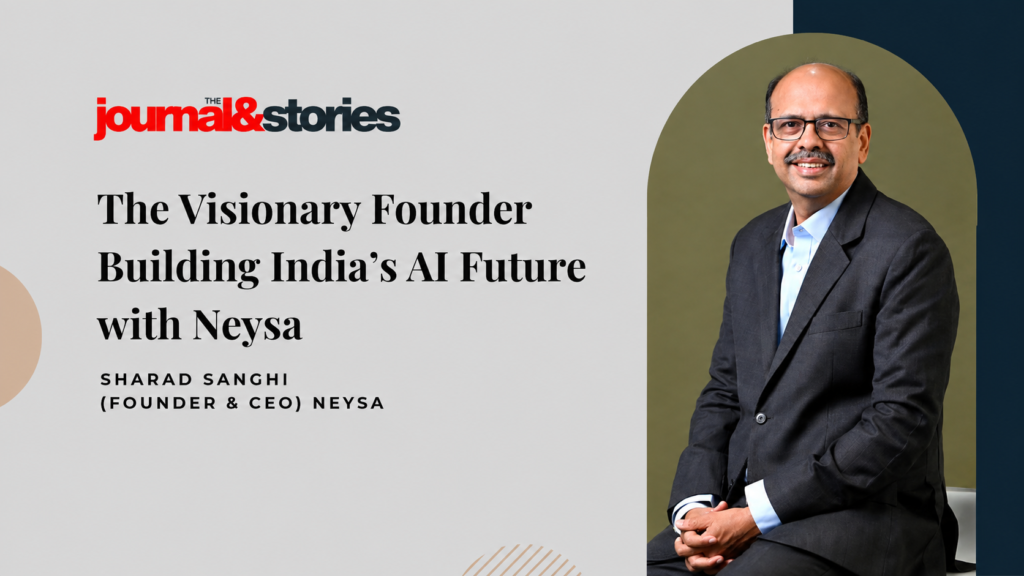















































































































































































































Sharad Sanghi: The Visionary Founder Building India’s AI Future with Neysa.
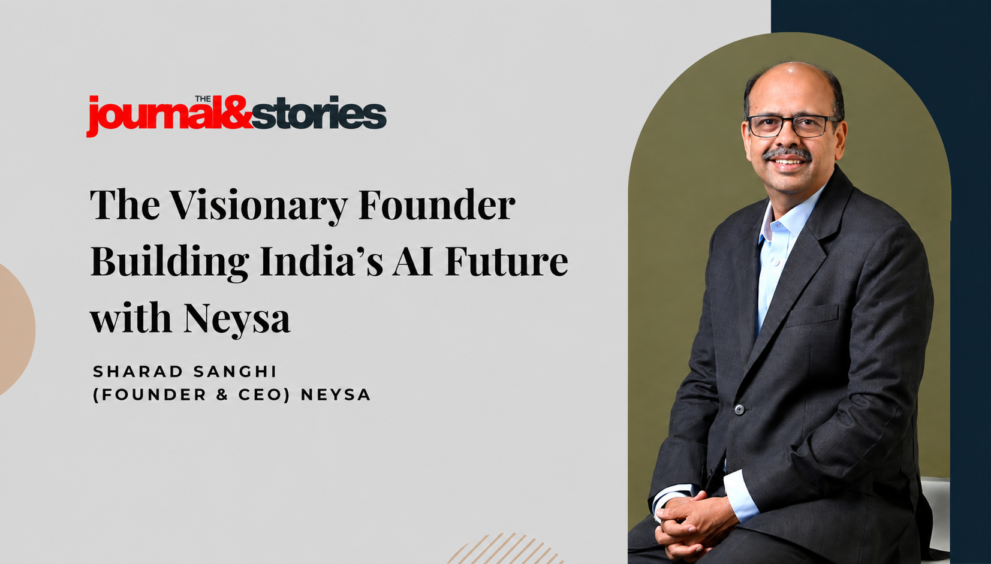

- Sharad Sanghi’s journey from Netmagic to Neysa reflects a consistent vision: building the infrastructure that enables the next generation of technology. His focus has now shifted from the internet and cloud era to the rapidly growing world of artificial intelligence.
- Neysa is taking an India-first approach to AI infrastructure, focusing on powerful computing, GPUs, security, and scalable systems. Its larger goal is to help Indian businesses participate more effectively in the global AI economy.
- With major investments and plans to expand its GPU infrastructure, Neysa is positioning itself to compete in a rapidly evolving global AI market. For Sharad Sanghi, this is another long-term opportunity to build the technology foundation behind a major digital transformation.
Sharad Sanghi continues today to develop new ground at the point where technology meets opportunity, having been a pioneer in setting up India’s data-centre industry.
When people discuss artificial intelligence, the subject usually focuses on chatbots, automation, large language models, and various future applications. Yet behind each powerful AI system there is something both much less obvious and considerably more important—infrastructure
A Technologist Who Started Ahead of the Curve
Sharad Sanghi’s journey into the world of technology started well before AI became a common topic in business discussions.
He studied Electrical Engineering at IIT Bombay and then did postgraduate study at Columbia University; the technical training he received provided him with a solid engineering background, whereas his entrepreneurial attitude eventually caused him to move on to the development of large-scale digital infrastructure.
Sanghi established Netmagic in 1998, a period when India’s internet ecosystem was still in its early days. Although the concept of having professional data centres and managed infrastructure was fairly new, Sanghi realised that India’s expanding digital economy would need reliable technology infrastructure.
Netmagic later became one of the key players in India’s data centre industry and was eventually bought out by NTT; during this time Sanghi earned a reputation as one of the pioneers in the development of India’s digital infrastructure ecosystem.
What is most noticeable in this phase of his career is his capacity to think beyond current trends.
While everybody else was concentrating on the advantages the internet could provide to consumers, Sanghi was considering what kinds of needs businesses would have beneath it.
That method later became the focus of his work with Neysa.
The Shift from Cloud to Artificial Intelligence
The increasing development of generative AI has led to a brand-new challenge in terms of infrastructure.
Modern AI models need a great deal of computing power; in order to train and operate sophisticated models it is necessary to use high-performance GPUs, specialized networking, large-scale storage, advanced software, and reliable data-center operations.
For businesses it can be both complicated and costly to build all of this on their own.
Sanghi realized that AI would need an infrastructure ecosystem specially designed for its particular workloads.
The vision played a role in the founding of Neysa, an AI infrastructure company which is concerned with helping businesses and organizations to adopt and scale artificial intelligence.
Neysa is an AI acceleration cloud company that combines computing infrastructure, AI platforms, security, and orchestration in order to enable businesses to build and run their AI workloads more effectively.
For Sanghi this is not just yet another opportunity for a startup.
It is the work which he started many years earlier.
Data centres were needed by the internet.
Scalable infrastructure was needed by the cloud.
Now AI requires specialized computing infrastructure.
What Makes Neysa Different?
The number of companies in the AI sector is such that many are creating applications and software tools; Neysa, however, is adopting a different approach.
Rather than mainly focusing on the visible application layer, it is concentrating on the infrastructure beneath AI.
That distinction is important.
Suppose a company is planning to create an AI-powered product; it might have capable developers and a good business idea, but it will still need access to computing power, GPUs, storage, networking, security, monitoring, and deployment tools.
The aim of Neysa is to create that fundamental ecosystem.
The company’s platform strategy involves products such as the Neysa Velocis, which is intended to support AI acceleration, as well as a range of solutions concerned with observability, security, and AI governance.
This shows a basic fact, namely that in order for enterprise AI to be successful it is necessary to have more than just powerful hardware.
It is essential for businesses to realise that their systems are secure, their workloads are operating efficiently, and that their data is being properly controlled.
Neysa’s method is therefore all about making AI infrastructure more accessible and easier for organisations to manage.
An India-First Vision
A prominent feature of Sanghi’s vision is his emphasis on the AI infrastructure ecosystem in India.
India possesses a large technology workforce, a swiftly expanding startup sector, many large companies, and a growing demand for AI solutions. Yet merely having software developers is not enough to establish a robust AI economy.
It also needs compute infrastructure.
It is here that local AI infrastructure can assume strategic importance.
Organisations that handle sensitive information might be worried about data security, compliance, latency, and the location where their workloads are processed. Possessing strong AI infrastructure in India could help meet some of these requirements.
Neysa is focusing on this opportunity which is India-first while at the same time seeking global scale.
For Sanghi the opportunity is in fact greater than setting up another technology company.
This is concerning the establishment of a foundation that will enable India’s involvement in the global AI economy.
Investment and Rapid Expansion
Neysa has also attracted a great deal of investment because of the increasing importance of AI infrastructure.
In 2024 Neysa announced a $30 million Series A funding round, the company saying that the funds would be used to scale its AI infrastructure and to speed up the adoption of generative AI.
After that, the company’s ambitions increased considerably.
In February 2026 Neysa announced a financing deal with Blackstone and some co-investors which could provide more than $1 billion in capital, comprising the intended equity and debt financing. The company stated that the funds would be used to help with its expansion and to implement a plan to deploy over 20,000 GPUs in India.
The extent of this investment shows just how rapidly the AI infrastructure market is developing.
It also points out the degree of competition that Neysa is going to encounter.
Competing in a Global Market
A global race is currently developing in the field of AI infrastructure.
Large cloud providers already possess vast computing resources, numerous data centres, and a wide range of business relationships. At the same time, specialised providers of AI infrastructure are establishing a new category that is dedicated to high-performance AI workloads.
Sanghi has admitted that Neysa’s main competition comes from the global hyperscalers rather than just from other Indian startups.
It is an ambitious position.
Instead of restricting Neysa to just the domestic sector, the company is trying to establish itself as a major player in the wider AI infrastructure market.
Its advantages might result from specialization, the existing local infrastructure, an understanding of the requirements of Indian enterprises, and the decades of infrastructure experience possessed by its leadership team.
The Leadership Philosophy Behind Sanghi’s Journey
A common thread runs through Sharad Sanghi’s career.
He has kept on concentrating on the technology which is working behind the scenes.
While the internet was expanding, he was working on data-centre infrastructure.
As companies shifted their focus to cloud services, the demand for scalable infrastructure increased.
AI is now creating another enormous demand for infrastructure.
It seems that Sanghi’s strength lies in identifying these infrastructure changes early on and setting up businesses based on them.
This calls for a different kind of entrepreneurial thinking.
It is rare for infrastructure companies to become widely known all at once; such companies need substantial investment, technical expertise, operational discipline, and a great deal of patience.
They also need leaders who realise that while technology may involve innovation, it is just as important in terms of reliability.
Experience in this area is especially valuable in the field of AI, since businesses nowadays expect their systems to operate securely and consistently.
Why Sharad Sanghi’s Story Matters
For the technology ecosystem in India, Sanghi’s experience provides a valuable lesson.
It isn’t necessary for entrepreneurship to consist in coming up with the next popular consumer application; some of the most significant opportunities can in fact be found behind the products that people use every day.
Even though consumers may not always be able to see data centres, cloud platforms, networking systems, cybersecurity measures, GPUs, and AI infrastructure, these elements form the basis of the digital economy.
Sanghi understood this early.
He contributed to the development of the infrastructure that enabled India’s internet era via Netmagic.
He is currently trying to develop infrastructure for India’s AI era through Neysa.
It is this aspect that gives his story particular relevance nowadays.
Looking Toward the AI-Driven Future
The industry involving AI is changing at an extraordinary rate.
New models are emerging, companies are carrying out experiments with automation, and businesses are gradually getting their AI projects from the testing stage into real-world production.
At the same time, the demand for AI infrastructure that is both reliable and scalable is probably going to rise.
For Neysa the difficulty will lie in turning its ambitious vision into infrastructure that is capable of competing on a global scale.
It is another chance for Sanghi to deal with a problem that lies underneath the major technological transformation.
It shows that he appreciates the value of playing the long game.
A Builder of What Comes Next
Sharad Sanghi’s story is more than simply one of entrepreneurship; it is also about timing, infrastructure, and long-term vision.
He joined the data centre industry at a time when India’s internet ecosystem was still in its early stages. Years later, he moved into AI infrastructure at a time when artificial intelligence is transforming businesses all over the world.
The technology may have changed, but the fundamental question remains the same:
What kind of infrastructure will be needed by the next technological revolution?
Sanghi is using Neysa as a means of trying to deal with that question in the context of the AI era.
If artificial intelligence is to play a basic role in India’s digital economy, the country will need more than just innovative AI applications.

