
























































































































































































From Jensen Huang to Steve Jobs: CEOs Who Were Ousted and Returned to Lead Their Companies
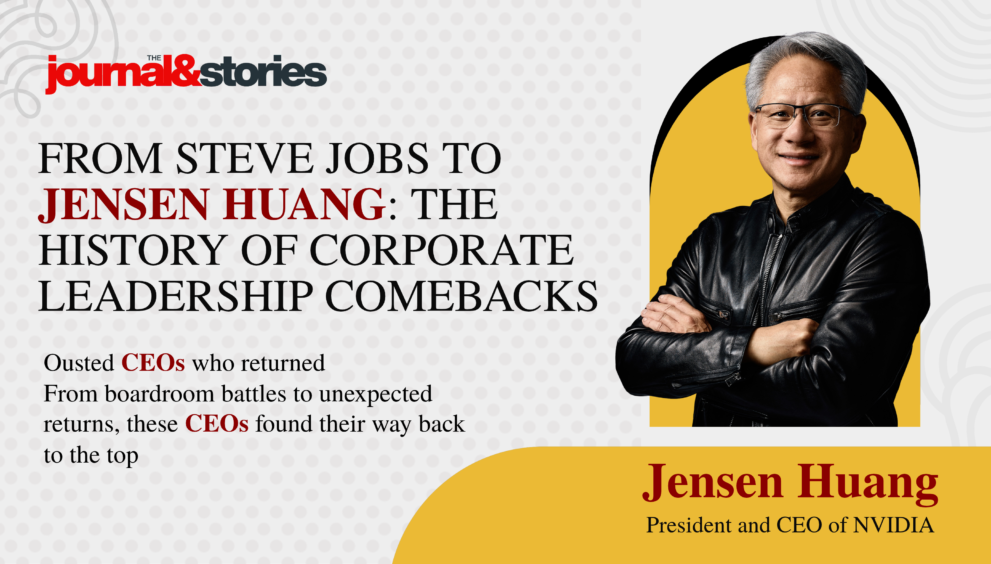

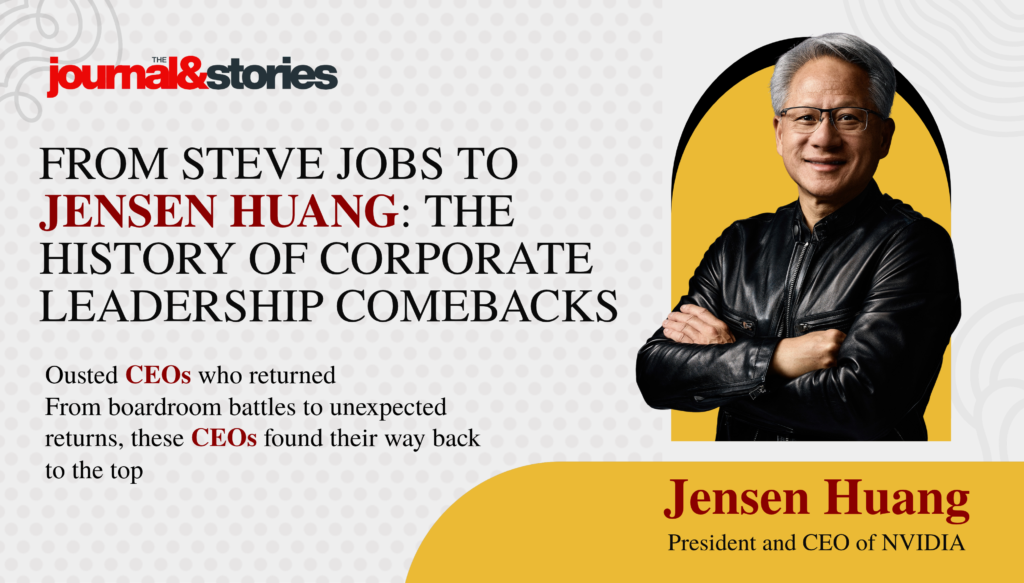
- Jensen Huang’s comeback: Nvidia reinstated its co-founder as CEO on November 23, 2026, just 11 days after his resignation.
- Steve Jobs’ historic return: After leaving Apple in 1985, Jobs returned in 1997 and led the company’s transformation.
- Sam Altman’s reinstatement: Employee opposition and pressure from stakeholders played a major role in his return to OpenAI in November 2023.
- Michael Dell and Bob Iger: Both executives returned to leadership positions when their companies faced strategic and business challenges
- The Boomerang CEO phenomenon: Former leaders can bring experience and stability, but their returns also raise questions about succession planning and corporate governance.
Jensen Huang’s return to Nvidia has renewed interest in the phenomenon of Boomerang CEOs. From Steve Jobs at Apple and Sam Altman at OpenAI to Michael Dell, Bob Iger, Howard Schultz and Jack Dorsey, several prominent executives have reclaimed their leadership positions after leaving their companies. Their stories highlight how founder influence, employee support, investor confidence and corporate challenges can shape executive comebacks.
Jensen Huang to Steve Jobs: Ousted CEOs Who Returned to Power
From boardroom battles to unexpected returns, these CEOs found their way back to the top
The history of global business is full of dramatic leadership changes, boardroom disagreements and unexpected corporate comebacks. While many chief executives leave their positions permanently after being removed or stepping down, some make a remarkable return to the very companies they once led.
From Apple’s legendary co-founder Steve Jobs to OpenAI CEO Sam Altman and Nvidia’s Jensen Huang, several prominent business leaders have reclaimed their positions after facing professional setbacks, leadership disputes or difficult corporate circumstances.
These executives are often described as ‘Boomerang CEOs’ — leaders who return to a company after previously leaving its top position. Their comebacks have happened for different reasons, including unsuccessful succession plans, declining business performance, employee pressure and the need for experienced leadership during uncertain periods.
Jensen Huang’s return to Nvidia on November 23, 2026, just 11 days after his resignation, has once again brought attention to this unusual corporate phenomenon. His case joins a list of high-profile leadership comebacks that includes Steve Jobs, Sam Altman, Michael Dell, Bob Iger and Howard Schultz.
Here are some of the most notable CEOs who returned to the top after leaving their companies.
1. Jensen Huang – Nvidia
Departure: November 12, 2026 | Return: November 23, 2026
Jensen Huang’s return to Nvidia has become one of the most extraordinary leadership developments in the technology industry in 2026. The Nvidia co-founder, who helped build the company into one of the world’s most influential semiconductor businesses, returned as its president and CEO just 11 days after stepping down.
Huang co-founded Nvidia in 1993 and played a central role in its development from a graphics processing company into a major force in artificial intelligence infrastructure. Nvidia’s graphics processing units (GPUs) have become essential components of modern AI development, data centres and high-performance computing.
On November 12, 2026, Huang resigned from his positions as president, CEO and board director. Following his departure, Nvidia’s Chief Financial Officer Colette Kress was appointed interim CEO.
The leadership change followed reports concerning Huang’s personal conduct and allegations involving a possible foreign intelligence operation. The circumstances surrounding his departure also attracted significant public and political attention.
However, the company’s board reversed its earlier decision and unanimously reinstated Huang on November 23. The board cited discussions and its confidence in his ability to lead the company. An independent investigation into the circumstances of his departure was set to continue.
His return also attracted attention from US President Donald Trump, who publicly supported his reinstatement.
The market reaction demonstrated how closely investors associate Nvidia’s future with Huang’s leadership. Nvidia shares surged following the announcement, highlighting his influence over investor confidence and the wider AI industry.
However, his comeback has also raised questions about corporate governance, board independence and the risks of depending too heavily on a single executive.
Why his return matters: Huang’s comeback demonstrates how a founder’s influence, industry relationships and strategic importance can shape a company’s leadership decisions, even when the board has already accepted his departure.
2. Steve Jobs – Apple
Departure: 1985 | Return: 1997
Steve Jobs’ comeback at Apple remains one of the most famous examples of a founder returning to rescue a struggling company.
Jobs co-founded Apple in 1976 alongside Steve Wozniak and Ronald Wayne. Under his leadership, Apple introduced innovative personal computers and established itself as an important name in the technology industry.
However, disagreements over management decisions and the company’s future direction created tensions between Jobs and then-CEO John Sculley.
In 1985, following a major power struggle, Jobs left Apple. His departure marked a difficult chapter in his professional journey, but he continued working in the technology and entertainment industries.
After leaving Apple, Jobs founded NeXT, a computer company focused on advanced computing systems. He also became involved with Pixar, which eventually developed into one of the world’s most successful animation studios.
Apple later acquired NeXT in 1996, bringing Jobs back into the company. In 1997, he became interim CEO before eventually taking the permanent position.
His return marked the beginning of a major transformation at Apple.
Jobs simplified the company’s product strategy, strengthened its design philosophy and focused on developing products that combined technology with user-friendly experiences.
Under his leadership, Apple introduced several iconic products, including the iMac, iPod, iPhone and iPad.
The iPhone, launched in 2007, fundamentally changed the mobile phone industry and established Apple as one of the world’s most influential technology companies.
Jobs resigned as CEO in August 2011 due to health reasons, with Tim Cook taking over the position.
Why his return matters: Steve Jobs demonstrated how a returning founder with a clear vision can transform a struggling company into a global market leader. His comeback remains a benchmark for corporate turnarounds.
3. Sam Altman – OpenAI
Departure: November 17, 2023 | Return agreement: November 22, 2023
Sam Altman’s return to OpenAI was among the most dramatic corporate leadership developments in the artificial intelligence industry.
Altman became widely recognised as the public face of OpenAI following the launch of ChatGPT in November 2022. The chatbot attracted global attention and accelerated the adoption of generative artificial intelligence.
However, in November 2023, OpenAI’s board suddenly announced that Altman would leave his position as CEO. The board cited concerns about his communications with directors and stated that it had lost confidence in his ability to lead the organisation.
The decision triggered an extraordinary internal crisis.
OpenAI employees expressed strong opposition to the board’s decision. More than 700 employees signed a letter threatening to leave the company unless Altman was reinstated.
Microsoft, one of OpenAI’s major investors and technology partners, also became involved in the situation. CEO Satya Nadella announced that Altman and other departing OpenAI employees could join Microsoft to lead a new advanced AI research team.
Following several days of uncertainty and negotiations, OpenAI announced an agreement in principle for Altman’s return as CEO on November 22, 2023. The agreement also included changes to the company’s board.
Altman’s return highlighted the influence employees, investors and strategic partners can have over corporate leadership decisions.
It also demonstrated the challenges of governing an organisation operating at the centre of a rapidly developing technology industry.
Why his return matters: The OpenAI episode showed that a board’s decision to remove a CEO can face significant resistance when employees, investors and commercial partners strongly support that leader.
4. Michael Dell – Dell Technologies
Departure: 2004 | Return: 2007
Michael Dell is another prominent founder who successfully returned to the CEO position after stepping away from daily leadership responsibilities.
He founded Dell in 1984 and built the company into one of the world’s leading computer manufacturers through its direct-sales business model.
In 2004, Michael Dell stepped down as CEO and handed the position to Kevin Rollins while remaining chairman of the company.
However, Dell faced increasing competition, changing consumer preferences and pressure to improve its business performance.
In January 2007, Michael Dell returned as CEO, replacing Rollins.
His second tenure involved a major strategic shift. Dell worked to strengthen the company’s enterprise technology business and reduce its dependence on traditional personal computer sales.
One of the most significant developments came in 2013, when Michael Dell took the company private through a major buyout transaction.
In 2016, Dell completed its acquisition of EMC, a major enterprise technology company. The transaction helped establish Dell Technologies as a much broader technology business with operations across computers, servers, storage and enterprise infrastructure.
Why his return matters: Michael Dell’s comeback demonstrates how founders can use their experience and long-term understanding of a business to reposition a company for changing market conditions.
5. Bob Iger – The Walt Disney Company
Departure: 2020 | Return: November 20, 2022
Bob Iger’s return to Disney was another significant example of a company reversing its leadership succession decision.
Iger first became Disney’s CEO in 2005 and led the entertainment company for 15 years. During his tenure, Disney expanded its global entertainment portfolio through major acquisitions, including Pixar, Marvel Entertainment, Lucasfilm and 21st Century Fox’s entertainment assets.
In February 2020, Iger stepped down as CEO and handed the position to Bob Chapek, who had previously served as Disney’s parks division chief.
Iger continued as executive chairman for a period, but the leadership transition did not deliver the results the board had expected.
Disney faced several challenges, including financial pressure in its streaming business, changing consumer behaviour and difficulties across parts of its entertainment operations.
On November 20, 2022, Disney announced that Iger would return as CEO, replacing Chapek.
The decision surprised the entertainment industry because Iger had personally selected Chapek as his successor.
During his second tenure, Iger focused on restructuring the company, improving financial discipline, strengthening its streaming operations and reviewing its broader business strategy.
His return reflected Disney’s belief that his experience and relationships across the entertainment industry could help the company navigate a challenging period.
Why his return matters: Iger’s comeback illustrates how boards may reverse succession decisions when a company’s performance and strategic direction do not meet expectations.
6. Howard Schultz – Starbucks
First departure: 2000 | First return: 2008 | Second return: 2022
Howard Schultz is one of the most notable examples of a business leader returning to the CEO position more than once.
Schultz played a major role in transforming Starbucks from a coffee retailer into a globally recognised coffeehouse brand.
He joined Starbucks in the 1980s and later helped develop the company’s distinctive coffeehouse experience. Under his leadership, Starbucks expanded rapidly across the United States and international markets.
In 2000, Schultz stepped down as CEO but continued to remain connected with the company as chairman.
However, by 2008, Starbucks was facing declining sales, increasing competition and concerns about its rapid expansion.
Schultz returned as CEO in January 2008 to lead a major turnaround.
His strategy focused on improving customer experience, strengthening the brand and addressing operational challenges. The company also made changes to its store operations and business strategy.
Schultz remained CEO until 2017, when Kevin Johnson took over.
In 2022, Schultz returned again as interim CEO following the departure of Kevin Johnson. His third leadership period lasted until March 2023, when Laxman Narasimhan became CEO.
Why his return matters: Schultz’s repeated comebacks demonstrate how founders and former leaders can become important resources for companies facing strategic and operational difficulties.
7. Jack Dorsey – Twitter
First departure: 2008 | Return: 2015
Jack Dorsey, one of Twitter’s co-founders, also experienced an unusual leadership journey.
Twitter was launched in 2006, and Dorsey initially served as its CEO. However, concerns about his management style and the company’s direction led to a leadership change in 2008.
Co-founder Evan Williams replaced him as CEO, while Dorsey remained chairman.
After leaving Twitter’s top position, Dorsey focused on building Square, a financial technology company that later became Block.
In October 2015, Twitter announced that Dorsey would return as CEO, replacing Dick Costolo.
His return came at a time when Twitter was facing challenges related to user growth, advertising revenue and competition from other social media platforms.
Dorsey attempted to improve the company’s product strategy and strengthen its business operations while continuing to lead Square.
However, his second tenure also faced criticism over Twitter’s business performance and leadership priorities.
In November 2021, Dorsey stepped down as CEO again, handing over the position to Parag Agrawal.
Why his return matters: Dorsey’s experience highlights both the advantages and difficulties of bringing a founder back to lead a company, particularly when that executive has responsibilities across multiple businesses.
What Makes a CEO Comeback Successful?
The return of a former CEO does not automatically guarantee a company’s success. While experienced leaders may understand a business better than external candidates, their second tenure can also bring new challenges.
There are several factors that influence whether a comeback works.
1. Familiarity with the business: Former CEOs understand the company’s culture, operations, employees and long-term challenges.
2. Investor confidence: A recognised leader can sometimes restore confidence among investors and business partners during uncertain periods.
3. Clear strategic direction: A returning executive needs more than an established reputation. They must have a realistic plan to address the company’s problems.
4. Strong corporate governance: Boards must maintain independent oversight and ensure that the returning CEO remains accountable.
5. A succession plan: Companies should avoid becoming excessively dependent on one individual and should develop capable future leaders.
As research discussed by the University of Pennsylvania’s Wharton School has highlighted, bringing back a former CEO can provide stability during a crisis, but it may also expose weaknesses in a company’s succession planning.
Conclusion
From Steve Jobs’ historic return to Apple to Sam Altman’s dramatic reinstatement at OpenAI and Jensen Huang’s extraordinary comeback at Nvidia, these stories demonstrate that leaving the CEO position does not always mean the end of a business leader’s journey.
Some returned after being removed, others stepped aside voluntarily, while several were brought back when companies struggled with leadership transitions or changing market conditions.
Their experiences also reveal an important lesson about corporate leadership: a company’s success depends not only on its products and financial performance but also on the people responsible for its long-term vision.
However, the real test of a returning CEO is not simply reclaiming the top position. It is whether they can deliver sustainable results, rebuild confidence and prepare the company for its next phase of growth.

